
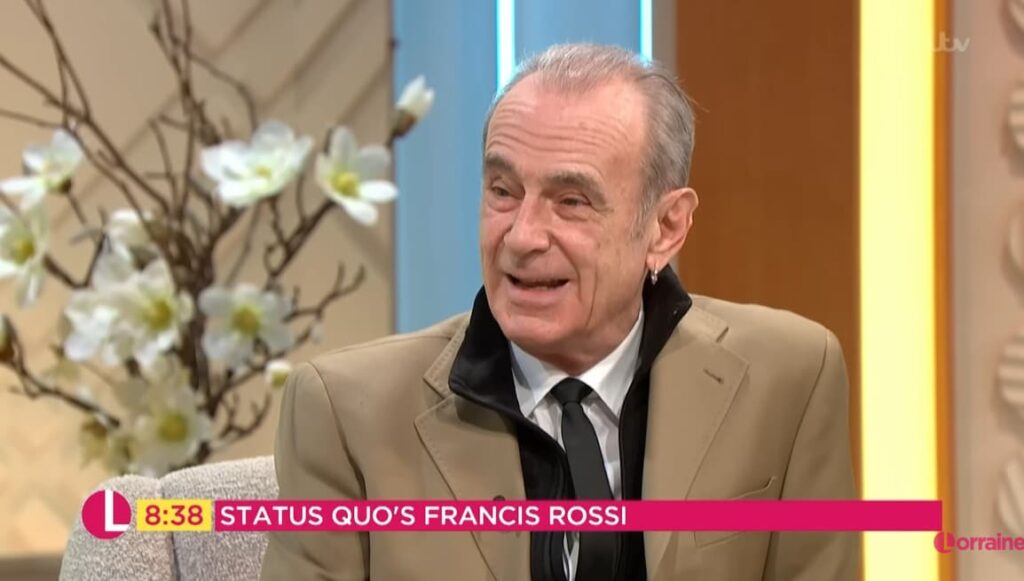
Francis Rossi on Loss, Friendship, and Letting Go: Remembering Rick Parfitt After Status Quo
For decades, Status Quo were synonymous with excess, endurance, and an unbreakable bond forged on the road. At the heart of that story stood Francis Rossi and Rick Parfitt, two musicians whose partnership defined the sound, image, and spirit of the band. Yet behind the familiar boogie rhythms and relentless touring schedule lay a personal relationship marked by loyalty, conflict, and ultimately, profound loss. In a revealing interview broadcast on 02 April 2019 on Lorraine, Rossi spoke candidly about his struggle to accept Parfitt’s death in 2016, offering a rare glimpse into grief after a lifetime spent together in music.
During Status Quo’s peak years, the band embodied the classic rock and roll lifestyle. Sex, drugs, and alcohol were part of the culture, not the exception. Rossi has been open about this era, but he also described a turning point when he chose to step away from drugs and alcohol. That decision, while life saving for him, quietly altered the dynamic between himself and Parfitt. As Rossi moved toward sobriety, Parfitt continued to drink heavily, and the once effortless closeness between them became strained. It was not a dramatic falling out, but rather a slow and painful distancing shaped by different paths and personal struggles.
Despite these tensions, Rossi emphasized that their bond never truly disappeared. They remained inseparable in the eyes of fans and, in many ways, inseparable in spirit. When Rick Parfitt passed away in December 2016, the impact on Rossi was deeper than he initially understood. He admitted that for the first year after Rick’s death, he regularly dreamed that his friend was still alive. In those dreams, Parfitt would turn up as if nothing had happened, ready to walk back on stage and resume where they left off. The stage, after all, was where their relationship had lived most fully.
These dreams reveal how difficult it was for Rossi to accept a reality without Parfitt. After more than fifty years of shared history, the absence was not just emotional but physical and habitual. Every performance, every backstage moment, and every familiar riff carried echoes of a partnership that had shaped British rock music for generations. Grief, in Rossi’s words, did not arrive all at once. It lingered, resurfaced, and often disguised itself as memory rather than loss.
Rossi’s reflections coincide with the release of his autobiography, I Talk Too Much, a title that hints at both self awareness and honesty. The book looks back on his long career, exploring not only fame and success, but also regret, survival, and the cost of living fast for too long. Parfitt’s story is an unavoidable part of that narrative, not as a mythic rock figure, but as a friend who struggled and was never truly replaced.
At the same time, Rossi has continued to move forward creatively. He is also releasing a new country album with Hannah Rickard titled We Talk Too Much, a quieter and more reflective project that contrasts sharply with the thunderous legacy of Status Quo. In many ways, it represents acceptance rather than escape.
Francis Rossi’s words on Lorraine were not about celebrity or nostalgia. They were about friendship, guilt, and the slow process of learning how to live with absence. For fans of Status Quo, they serve as a reminder that behind the relentless rhythm and iconic choruses were two human lives, bound together by music, and separated too soon by time.