
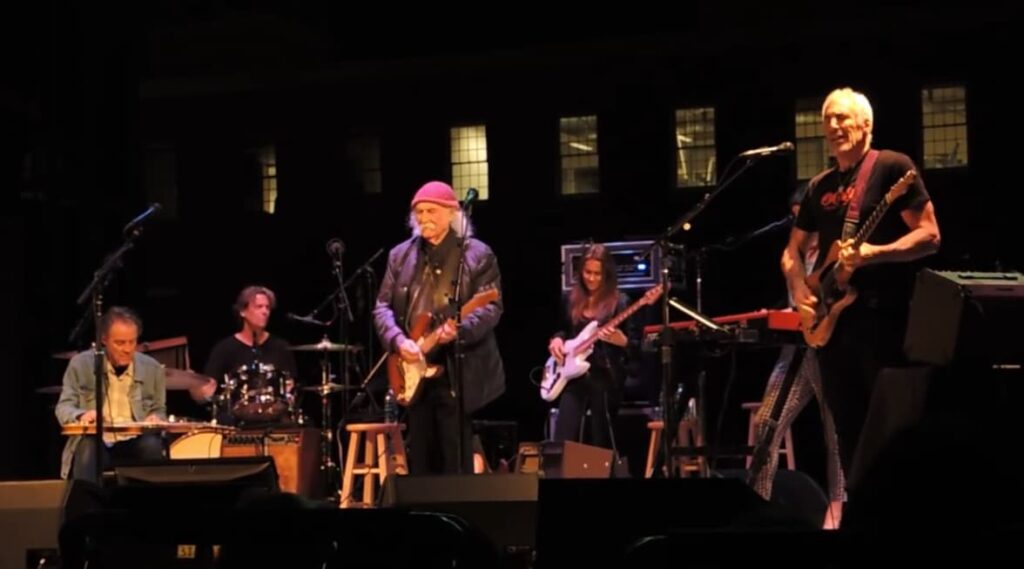
A Quiet Testament to Peace and Memory David Crosby Performs Wooden Ships in Lowell
On June 14 2018, David Crosby delivered a deeply affecting performance of Wooden Ships as part of the Lowell Summer Music Series at Boarding House Park, offering audiences a moment of reflection shaped by history, conviction, and enduring artistry. The evening stood as a reminder of Crosby’s singular voice in American music and his lifelong commitment to songs that speak beyond their era.
Wooden Ships, co written during Crosby’s time with Crosby Stills and Nash alongside Stephen Stills and Paul Kantner, has long been regarded as one of the most contemplative works to emerge from the late nineteen sixties. Introduced to the Lowell audience with calm assurance, the song unfolded not as a nostalgic artifact but as a living statement. Crosby’s delivery emphasized clarity and restraint, allowing the weight of the composition to resonate without embellishment.
The setting at Boarding House Park contributed significantly to the atmosphere of the performance. Open air and intimate in scale, the venue allowed Crosby to connect directly with listeners, many of whom were well aware of the song’s historical context. Written during a period marked by social unrest and fears of global conflict, Wooden Ships envisions escape not as fantasy but as moral necessity. In 2018, its themes felt neither dated nor distant.
Crosby’s vocal performance was measured and expressive, shaped by decades of experience rather than technical showmanship. His phrasing reflected an artist who understands the power of understatement. Each line was delivered with care, reinforcing the sense that this song still carried personal meaning for him. The audience responded with focused attention, creating a shared silence that underscored the seriousness of the moment.
As part of the Lowell Summer Music Series, the performance highlighted the festival’s role in presenting artists whose work bridges generations. Crosby’s appearance drew not only longtime admirers but also younger listeners encountering Wooden Ships in a live setting for the first time. The song’s message of survival, trust, and collective responsibility seemed to reach across age and background.
This performance of Wooden Ships did not rely on spectacle or reinterpretation. Instead, it reaffirmed the song’s original intent while allowing it to breathe in a modern context. Crosby stood not as a relic of a past movement, but as an active voice reminding audiences that music rooted in conscience can remain relevant without alteration.
In Lowell, David Crosby offered more than a song. He offered perspective, memory, and a quiet call for awareness, delivered with the authority of an artist who has spent a lifetime believing that music can still matter.