
“Space Station No. 5” Takes Off in London: Montrose Deliver a Fierce 1974 Performance at the BBC
In 1974, the American hard rock band Montrose stepped onto a modest television stage in London and delivered a performance that still resonates with rock fans decades later. Their appearance on the influential BBC music program The Old Grey Whistle Test featured a blistering live rendition of “Space Station No. 5”, a track originally released on the band’s 1973 debut album Montrose. What might have seemed like a routine television session at the time has since become a fascinating snapshot of early American hard rock making its mark on British audiences.
From the opening seconds of the performance, guitarist Ronnie Montrose establishes the dramatic tone that defines the piece. Rather than launching straight into the main riff, he manipulates his guitar effects pedals to produce a rising, mechanical sound that resembles a jet engine or spacecraft ignition. For television viewers in 1974, this introduction must have sounded remarkably futuristic. Guitarists were only beginning to explore the expressive possibilities of pedal effects, and Montrose used them not merely for distortion but for storytelling, evoking the cosmic imagery suggested by the song’s title.
When the famous riff finally lands, it hits with impressive force. The sound is thick and aggressive, driven by Montrose’s commanding guitar tone and anchored by the tight rhythm section of bassist Bill Church and drummer Denny Carmassi. The arrangement highlights the band’s precision and their ability to translate a studio recording into an even more powerful live performance.
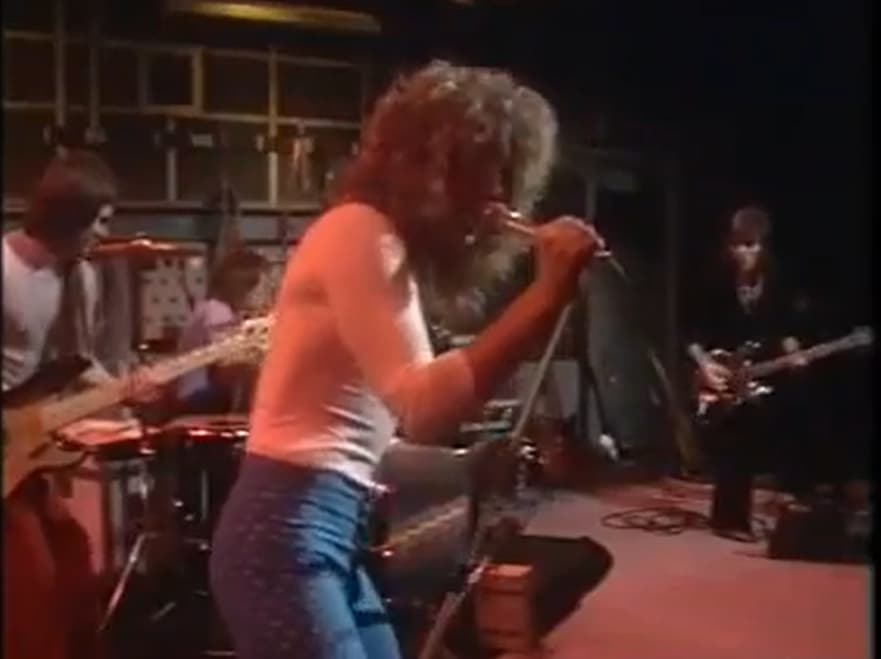
Frontman Sammy Hagar adds another compelling dimension to the broadcast. In the BBC studio environment, which was often known for restrained and almost formal performances, Hagar brings an unmistakably American stage presence. With his curly hair, restless movement, and powerful voice, he injects a level of energy that contrasts sharply with the controlled setting of the television studio. Even in this early footage, it is easy to see why he would later become one of the most recognizable figures in hard rock and eventually join Van Halen years later.
One of the most striking moments arrives at the end of the performance. Unlike the original studio version, the BBC rendition pushes the tempo dramatically in its closing section. The band accelerates into a rapid, almost chaotic finale, yet the musicians maintain tight control of the arrangement. The result is an explosive ending that feels spontaneous while still demonstrating the group’s technical discipline.
Programs like The Old Grey Whistle Test were essential platforms for serious rock music during the 1970s. Instead of flashy stage production, the show focused on musicianship, giving artists the opportunity to present their work directly to television audiences. Montrose’s performance of “Space Station No. 5” fits that format perfectly. With little more than amplifiers, microphones, and raw musical power, the band transformed a small BBC studio into a launchpad for one of hard rock’s most memorable live television moments.