
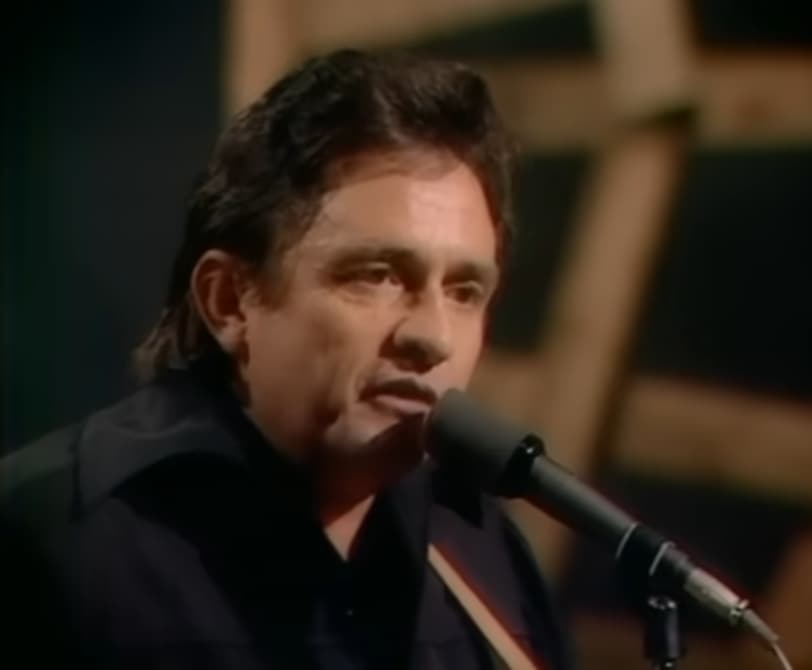
A Quiet Stage, A Powerful Presence: The Night Johnny Cash Held a Room Without Trying
In 1971, at a television studio in Copenhagen, Johnny Cash delivered a performance that continues to resonate decades later. The live rendition of I Walk the Line from this session stands as a masterclass in restraint, control, and authenticity. There were no elaborate stage effects, no dramatic build ups, and no attempt to overwhelm the audience. Yet the performance remains deeply compelling.
Filmed as part of a Danish television special during Cash’s Scandinavian tour, the setting was intimate and understated. This was not a comeback moment or a struggle for relevance. It was the peak of an artist fully in command of his voice, his image, and his message. Surrounded by a remarkable ensemble that included June Carter Cash, Carl Perkins, The Statler Brothers, and The Carter Family, the atmosphere felt less like a commercial production and more like a gathering of musical legacy.
What makes this particular performance of I Walk the Line so enduring is the alignment between the song’s message and the man delivering it. Originally written as a declaration of loyalty and self discipline, the song carried new weight in 1971. By this point, Cash had already faced personal battles and public scrutiny. Standing beside June Carter, the woman who would become central to his stability, the lyrics no longer sounded like a promise. They felt like something tested and lived.
Musically, the performance is defined by precision. The subtle key changes that characterize the song are handled with quiet confidence. There is no visible strain, no need for exaggeration. Cash’s voice remains steady, grounded, and deliberate. Each phrase lands with intention, reinforcing the sense that control, both musical and personal, is at the heart of the performance.
Equally striking is the audience dynamic. There is no visible frenzy, no loud reaction demanding attention. Instead, there is focus. The kind of silence that signals engagement rather than absence. It is a reminder that true presence on stage does not always come from volume or spectacle, but from clarity and conviction.
More than fifty years later, this recording continues to attract viewers not because it tries to impress, but because it refuses to. In an era dominated by overproduction, Johnny Cash’s Denmark performance offers a different lesson. When an artist is fully grounded in who they are, even the simplest moment can become unforgettable.