
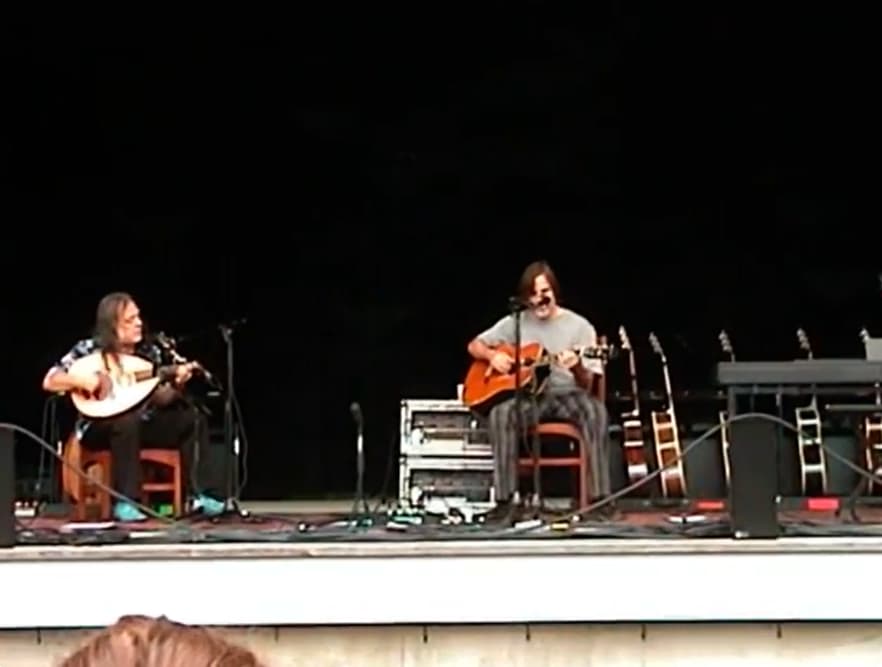
Where Friendship Becomes Music: Jackson Browne and David Lindley Reunite on a Quiet Stage
At the 2006 Philadelphia Folk Festival, Jackson Browne and David Lindley delivered a performance that felt less like a concert and more like a conversation between two lifelong collaborators. Their rendition of “Too Many Angels” stood out as a moment of rare intimacy, shaped by decades of shared musical history and an unspoken understanding that few partnerships achieve.
The setting played a crucial role in defining the tone of the performance. The Philadelphia Folk Festival has long been associated with authenticity and tradition, a space where songwriting and musicianship take precedence over spectacle. In this environment, Browne and Lindley stripped their music down to its essentials. There were no elaborate arrangements or studio enhancements, only voice, strings, and the subtle interplay between two artists who have spent years refining their craft together.
Originally released in the early 1990s, “Too Many Angels” carries themes of reflection and emotional complexity. In this live interpretation, those themes were given new weight. Browne’s vocal delivery was measured and deeply expressive, shaped by the passage of time and experience. Lindley, known for his distinctive approach to string instruments, added texture and nuance, transforming each phrase into something fluid and alive. His playing did not simply accompany the song but expanded its emotional range.
What makes this performance particularly compelling is the sense of continuity it represents. Browne and Lindley first worked together during the formative years of the Southern California music scene, contributing to a sound that would influence generations of singer songwriters. Decades later, their collaboration remains intact, not as a nostalgic exercise but as an evolving artistic dialogue. The years have not diminished their connection. Instead, they have deepened it.
There is also a quiet narrative embedded within the performance. As artists who have navigated changing musical landscapes, Browne and Lindley return here to a format that emphasizes sincerity over scale. The absence of a large stage or elaborate production allows the audience to focus entirely on the essence of the song. Every pause, every subtle shift in tone carries significance.
In an era often defined by digital precision and production complexity, this performance offers a reminder of a different standard. It highlights the enduring power of simplicity, the value of musical partnership, and the ability of a song to grow alongside those who perform it. For those in attendance and for those who revisit the recording, “Too Many Angels” becomes more than a composition. It becomes a living document of friendship, time, and the quiet strength of enduring artistry.