
Sometimes I forget that music was once an art and not a business
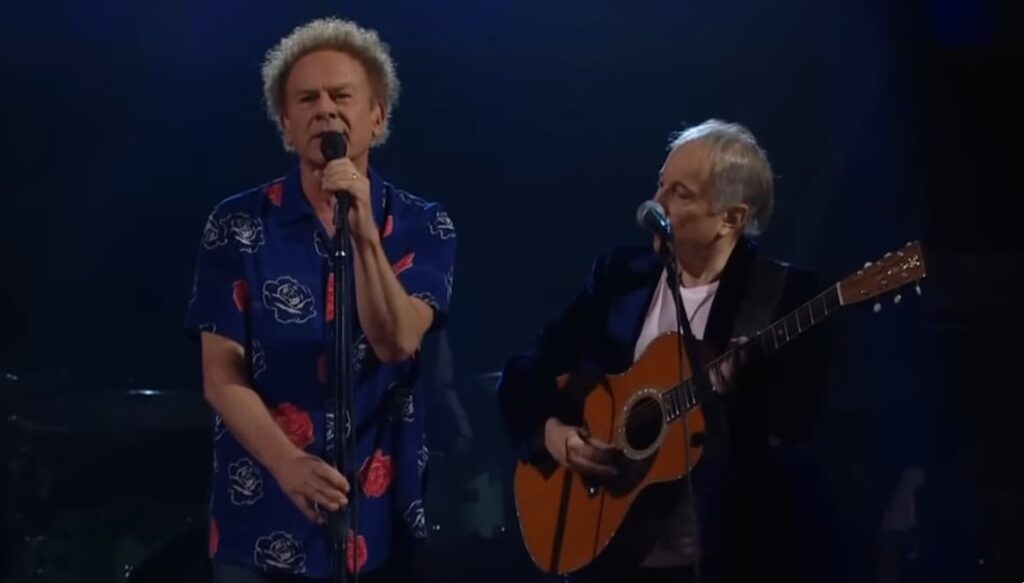
At the 25th Anniversary Rock and Roll Hall of Fame Concert, one of the evening’s most arresting moments arrived not with spectacle, but with restraint. As Simon & Garfunkel stepped into the light at Madison Square Garden on October 29, 2009, the atmosphere shifted. A vast arena that had hosted decades of amplified celebration suddenly leaned into stillness.
The choice of “The Sound of Silence” was deliberate and deeply symbolic. It was the song that first introduced their partnership to the world in the mid 1960s, and here it returned as a quiet anchor in a career marked by both brilliance and fracture. The performance unfolded with minimal arrangement, allowing the song’s architecture to breathe. Paul Simon carried the grounded phrasing with measured clarity, while Art Garfunkel floated above with a voice that retained its unmistakable purity. Time had altered texture, but not identity.
What made this rendition compelling extended beyond musical precision. Their history hovered in every line. Decades of creative tension and intermittent reunions gave the performance a fragile quality, as though each shared note was both an offering and a negotiation. Observers noted a certain physical distance between them on stage, a subtle but telling detail that echoed the song’s meditation on disconnection. In that sense, the performance carried a rare internal symmetry. A song about failed communication delivered by two artists long defined by complicated communication created an emotional feedback loop that few live moments achieve.
The audience response underscored this dynamic. There was no immediate eruption at the final chord. Instead, a brief, collective pause settled across the arena before applause rose. That hesitation felt less like uncertainty and more like recognition. Listeners seemed aware they had witnessed something that transcended nostalgia. It was not merely a revival of a classic, but a reframing shaped by time, experience, and unresolved history.
In a concert designed to celebrate legacy, this performance resisted easy sentiment. It asked a quieter question about relevance. In an era saturated with constant digital exchange, the song’s central idea still resonates with striking accuracy. The notion of hearing without truly listening has arguably intensified, giving the piece renewed cultural weight.
This appearance did not attempt reinvention. Its strength lay in continuity and contrast, in how a familiar composition could carry new meaning when placed against the lived reality of its performers. For many in attendance, it was a reminder that some songs do not age. They deepen, gathering layers that only time can provide.
 Oldies Songs
  Great Songs