
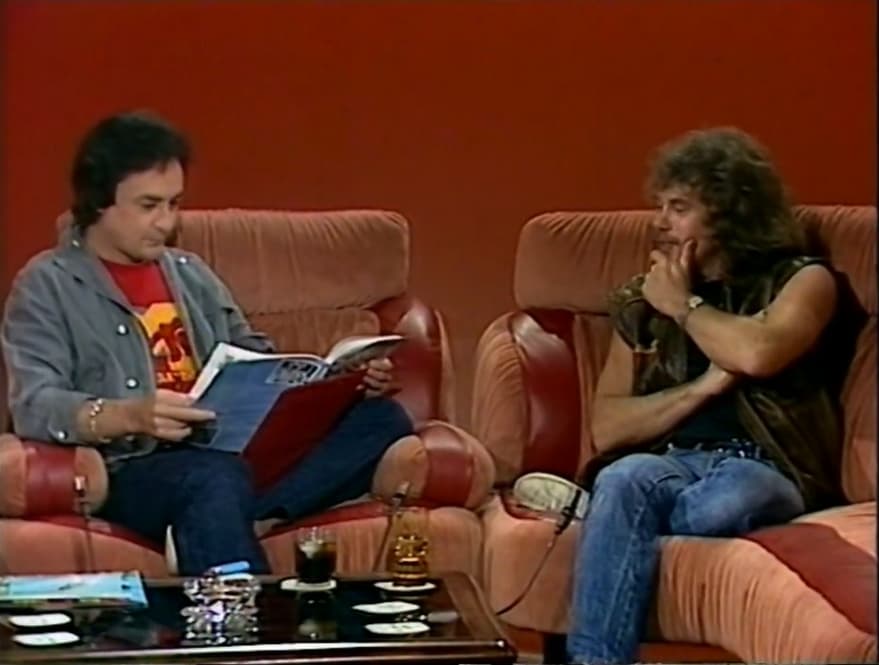
After Dark 1985 Alan Lancaster Reflects on Status Quo and a Changing Future
In 1985, bassist Alan Lancaster of Status Quo appeared on the television program After Dark for a candid and relaxed interview that offered insight into both the band’s longevity and his personal direction at the time. Speaking with host Donnie, Lancaster discussed more than two decades with Status Quo, addressing rumors of a split, the band’s future plans, and his growing interest in production work.
At the time of the interview, Lancaster noted that he had been part of Status Quo for approximately twenty three years. He reflected on how the group began during school days, when he and Francis Rossi first played together as teenagers. Touring had started remarkably early, with performances in clubs while still in their early teens. Before settling on the name Status Quo in the early nineteen sixties, the band had performed under several different names, including The Spectres and Traffic. These formative years laid the foundation for what would become one of Britain’s most durable rock acts.
Addressing speculation that the band had split, Lancaster clarified that although a recent European tour had been described as the last of its kind, it did not signal the end of Status Quo’s live performances. Concerts in other territories, including the United States, Japan, and Australia, remained possible. He suggested that while the group might gradually reduce large scale touring over the coming years, they were still active and committed to performing as long as circumstances allowed.
The discussion also touched on the compilation album 12 Gold Bars, which highlighted the band’s substantial chart history in the United Kingdom. When asked how many hits Status Quo had achieved over the years, Lancaster admitted he had lost count. The band’s consistent presence on the charts through the nineteen seventies and into the nineteen eighties underscored their commercial durability.
Beyond his role as a performer, Lancaster expressed interest in transitioning toward production work, particularly in Australia, where he was living at the time. He spoke about the depth of musical talent in the country and suggested that many artists struggled to gain international exposure without relocating overseas. While he did not publicly name specific acts he was working with, he confirmed that he had begun mentoring emerging musicians.
The interview also briefly addressed his family life, including lighthearted comments about his son’s interests outside of music. The tone throughout remained informal yet reflective, capturing Lancaster at a point where he was balancing pride in Status Quo’s achievements with consideration of what might come next.
After Dark provides a valuable snapshot of Alan Lancaster in 1985, positioned between an established legacy and a potential new chapter in music production.