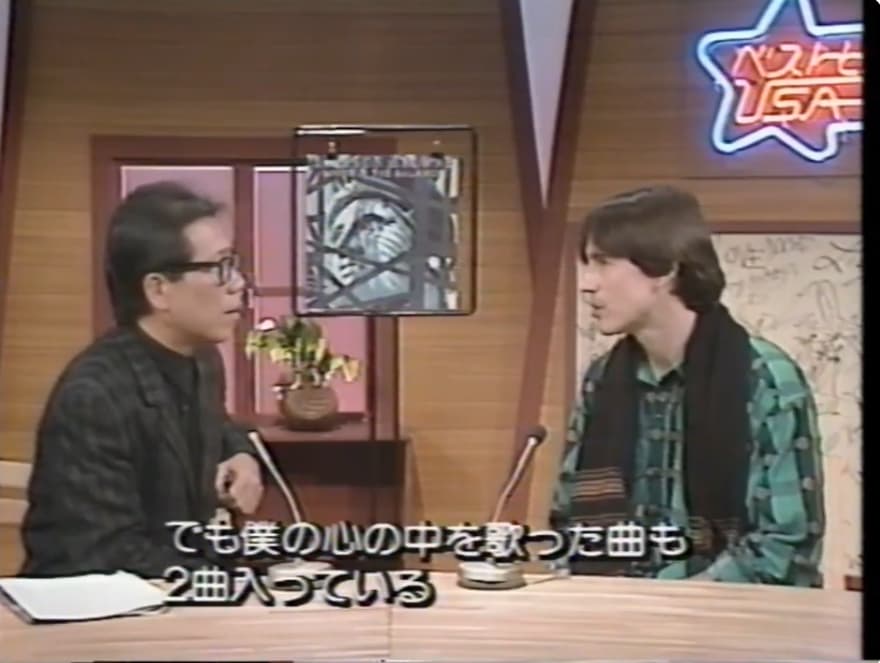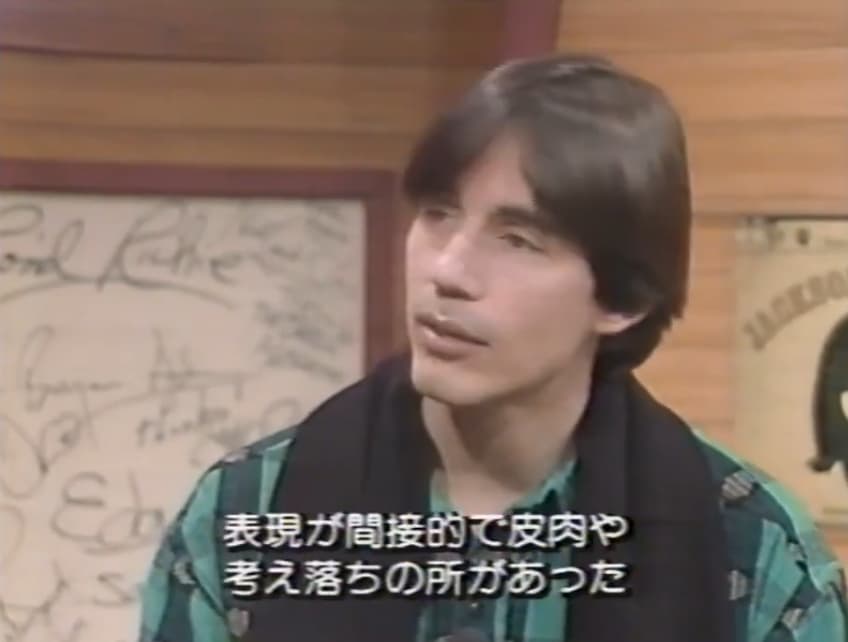
Jackson Browne on Japanese Television in 1987: A Quietly Powerful Moment of Conviction and Clarity
In 1987, Jackson Browne appeared on a Japanese television program that offered more than a routine promotional interview. What emerged instead was an intimate and thoughtful portrait of an artist in the middle of one of the most morally focused periods of his career. Aired during a time of global tension and political uncertainty, the broadcast captured Browne speaking with unusual openness about his music, his beliefs, and the responsibilities he felt as a songwriter and citizen.
The conversation begins on a warm and reflective note. Browne reconnects with the interviewer, recalling a previous meeting several years earlier at his loft studio in downtown Los Angeles. He speaks fondly of that space, not as a traditional recording studio but as a large, open room where his entire band could remain set up and ready to play. It was a place defined by practicality rather than polish, a reflection of Browne’s working philosophy. Music, for him, was about presence and honesty rather than technical separation or spectacle.
As the interview deepens, the focus shifts to his then recent album Lives in the Balance, released in 1986. Browne acknowledges a clear change in tone compared to earlier work. Where past albums often relied on suggestion, metaphor, and emotional subtext, this record was deliberately more direct. He contrasts it with Lawyers in Love, noting that while political ideas were present there, they were delivered through satire and irony. This time, Browne chose clarity over ambiguity.
He explains that the songs were written not to instruct or lecture, but to express deeply held convictions. His comments on United States involvement in Central America are calm but firm. He speaks of civilian suffering in El Salvador, covert support in Nicaragua, and the uncomfortable truth that such actions were funded by ordinary taxpayers. Browne emphasizes awareness rather than conclusion. His aim is not to tell listeners what to think, but to encourage them to look more closely at what is being done in their name.
At the same time, Browne is careful to remind viewers that Lives in the Balance is not solely a political statement. Songs such as “Shape of a Heart” and “Black and White” are highlighted as deeply personal and introspective pieces, rooted in relationships and inner reflection. This balance between the public and the private has always been central to Browne’s songwriting, and the interview makes clear that one does not exist without the other.
The discussion later turns to music videos, a medium Browne approaches with caution. He speaks candidly about the risks of commercial excess and the ease with which a video can distract from the song itself. For one particular project, he chose to finance the video personally in order to maintain artistic control and strip away unnecessary gloss. His goal was simple representation, allowing the song to speak without interference, especially at a time when the political issues he addressed were becoming more urgent.
This 1987 Japanese television appearance stands today as a rare and valuable document. It captures Jackson Browne not in performance, but in reflection. Thoughtful, composed, and quietly resolute, he presents an artist fully aware of his platform and unafraid to use it with integrity. Nearly four decades later, the conversation remains strikingly relevant, a reminder of the enduring power of music grounded in conscience and clarity.
Video: