
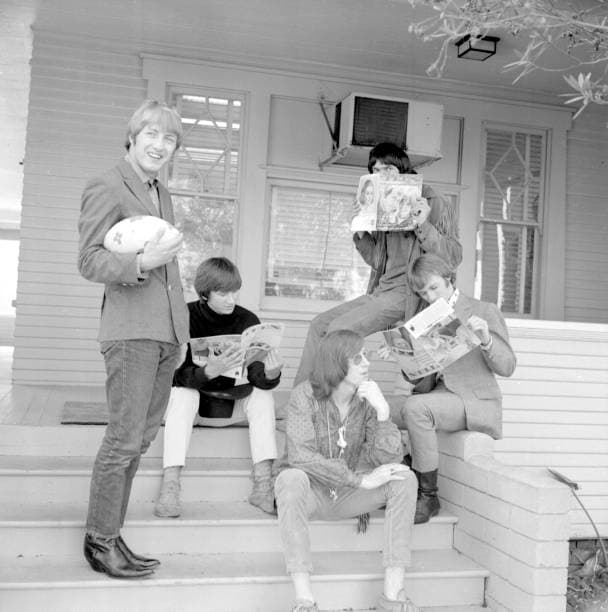
“Hot Dusty Roads”: A Raw, Restless Portrait of Early Folk-Rock Wanderers.
For those of us who bore witness to the seismic shifts in popular music during the mid-to-late 1960s, a few bands truly stood as architects of new sounds, blending the raw energy of rock and roll with the lyrical depth of folk. Buffalo Springfield was undeniably one of these pivotal groups, a supergroup in the making whose brief but brilliant career ignited the flames of folk-rock and set the stage for much that followed. While their more famous anthems like “For What It’s Worth” captured broad societal anxieties, deeper cuts and album tracks often revealed the personal, restless spirit that fueled their creativity. Their 1966 track, “Hot Dusty Roads,” from their self-titled debut album, Buffalo Springfield, offers a gritty, evocative snapshot of life on the road – a tale of wanderlust, loneliness, and the relentless pursuit of something just beyond the horizon. For older readers, it’s a potent flashback to a time when idealism mingled with uncertainty, and the open road called with irresistible allure.
Released on their debut album, Buffalo Springfield, in December 1966, “Hot Dusty Roads” was never issued as a standalone single and therefore did not chart on the Billboard Hot 100 or other major singles charts. Its significance, however, lies squarely within the context of the album itself, which was a critical and commercial success, peaking at number 80 on the Billboard 200 album chart in the United States. This debut served as a foundational text for the emerging folk-rock movement, introducing the world to the prodigious songwriting talents of Stephen Stills, Neil Young, and Richie Furay, alongside the solid rhythm section of Bruce Palmer and Dewey Martin. “Hot Dusty Roads” quickly became an album track beloved by fans who delved deeper than the radio hits, appreciated for its raw energy and authentic portrayal of the band’s nascent journey.
The story behind “Hot Dusty Roads” is intrinsically tied to the very genesis of Buffalo Springfield and the circumstances that brought these exceptional musicians together. The band members, many of whom had already been traversing the North American landscape in various musical endeavors, famously converged in Los Angeles, drawn by the burgeoning music scene of the Sunset Strip. The song itself, penned by Stephen Stills, vividly captures the transient, often challenging, existence of a touring musician or indeed any young person seeking their fortune in a new land. It’s born from direct experience – the endless drives, the sparse accommodations, the constant movement from one town to the next, hoping to catch a break. Stills’ lyrics reflect this restless spirit, encapsulating the fatigue and yearning that accompany a life spent chasing dreams down an endless highway.
The meaning of “Hot Dusty Roads” is a powerful evocation of the struggle and optimism inherent in artistic pursuit and a nomadic lifestyle. It speaks of physical discomfort (“Got a worn out pack and a hungry gut”) and the emotional toll of constant movement (“And the friends I make along the way / All seem to fade when I don’t stay”). Yet, despite the hardships, there’s an undeniable undercurrent of hope and resilience. The protagonist continues to move forward, driven by an internal compass (“Got to move, got to make a show / Got to ride this road, got to let it go”). It’s a testament to the youthful determination to forge one’s own path, even if that path is arduous and uncertain. For older readers, this song resonates deeply with memories of youthful adventures, of striking out on one’s own, of seeking purpose and experience far from the comforts of home. It captures that unique blend of fear and excitement that comes with embracing the unknown, the scent of adventure on the very air.
In the broader context of Buffalo Springfield the album, “Hot Dusty Roads” serves as a crucial piece of the puzzle, establishing a core theme of wanderlust and the search for identity that would permeate much of their work. It stands as a gritty, authentic snapshot of a band on the cusp of greatness, pouring their real-life experiences into their music. Even without charting as a single, its raw honesty and evocative imagery have ensured its place as a timeless representation of a significant era in rock history, still resonating with the heart of anyone who has ever felt the pull of the open road and the promise of what lies just around the next bend.