
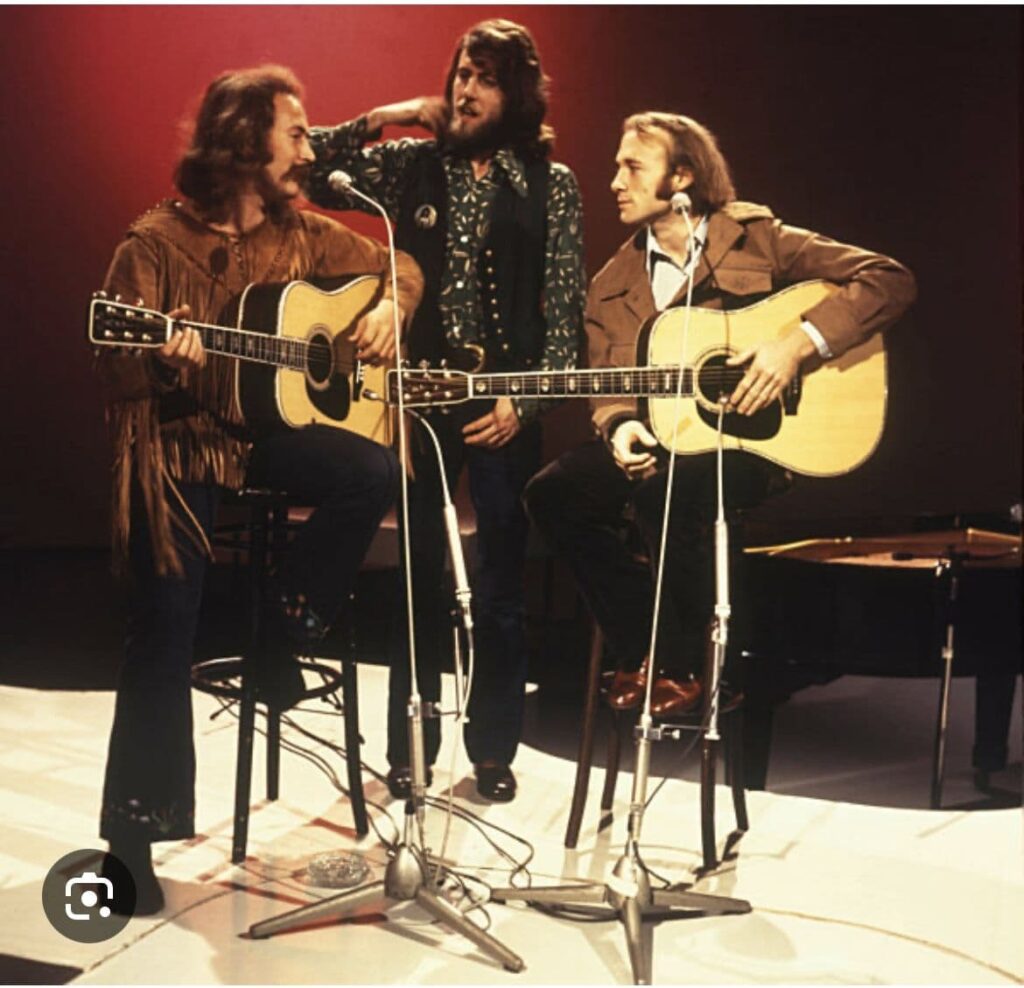
An Epitome of Folk-Rock Harmony, This Track Captures the Tender, Tortured Agony of Lost Love and Emotional Paralysis.
To speak of “Helplessly Hoping” is to invoke the very spirit of the late 1960s, a time when anguish over broken hearts and broken promises was often channeled into music of exquisite, ethereal beauty. It stands as perhaps the purest showcase of the sublime vocal architecture that defined the supergroup Crosby, Stills & Nash, a testament to the fact that three singular voices could merge into something that sounded truly celestial. This delicate, acoustic gem is a cornerstone of their 1969 debut album, Crosby, Stills & Nash, and remains one of the most poignant folk-rock ballads ever recorded.
Key Information: “Helplessly Hoping” was a track on the wildly successful debut album Crosby, Stills & Nash, released on May 29, 1969. While it was not a charting A-side single, it was chosen as the B-side to the band’s debut single, “Marrakesh Express,” in June 1969, ensuring it was heard widely on radio. The album itself was a phenomenon, soaring to No. 6 on the US Billboard Top Pop Albums chart and becoming a multi-platinum benchmark for the era. The song’s enduring legacy rests not on chart placement, but on its profound emotional impact and its status as the perfect vehicle for the trio’s revolutionary harmony sound.
The story behind “Helplessly Hoping” is a piece of classic rock and roll drama, a chapter torn straight from the pages of a complicated romance. It was written by Stephen Stills during the turmoil surrounding his painful and highly public breakup with folk singer and icon Judy Collins. Stills, known for his fiery temperament and musical genius, channeled his raw emotional vulnerability into this crystalline piece. The split had also inspired his other towering composition on the album, the seven-minute epic “Suite: Judy Blue Eyes.” Where “Suite” was a grand, sweeping declaration of love and loss, “Helplessly Hoping” is an intimate, hushed confession—the quiet moment of agony after the initial shock has passed. The legendary alliterative opening line, “Helplessly hoping, her harlequin hovers / Nearby, awaiting a word,” uses a poetic, almost Shakespearean language that elevates a personal tragedy to universal art.
The core meaning of the song is emotional paralysis in the face of uncertainty. It captures the exact moment when a lover is suspended in agonizing limbo, unable to move forward but powerless to turn back. The lyrics use clever wordplay and dual meanings to explore this sense of irresolution. The verse, “They are one person / They are two alone / They are three together / They are for each other,” is famously interpreted in several ways: as a description of a couple (one person) separating (two alone) and reuniting in a painful triangle (three together), or simply as a reference to the three distinct voices of Crosby, Stills, and Nash merging into one perfect whole.
What strikes a chord, especially with older, well-informed readers, is the sheer, devastating beauty of the vocals. It’s an a cappella masterclass, with Stills’ gentle lead guitar intro giving way to the incredible stacking of the voices—Stills’ warm tenor, Crosby’s high, haunting counter-melody, and Nash’s soulful lower harmony—building layer by layer to a moment of breathtaking sonic unity. It’s a moment that truly captures the bittersweet quality of that time: the world was turbulent and uncertain, but the music, at least, was profoundly, perfectly in tune. The song’s short run time only amplifies its dramatic intensity, leaving the listener with a sense of hopeful sorrow that lingers long after the final chord fades.