
The Moment of Pure Harmony: An Accidental Song That Forged the Sound of a Generation’s Yearning.
There are songs that define a moment, and then there are those that create one. “You Don’t Have to Cry” by Crosby, Stills & Nash belongs unequivocally to the latter. It is the three-minute, crystalline recording of a miracle—a moment of accidental magic that gave the world the sonic template for the entire singer-songwriter movement of the 1970s. For those of us who lived through that tumultuous, idealistic era, this track is more than music; it’s the sound of three broken birds taking tentative flight together, creating something more beautiful than the sum of their prodigious, fractured parts.
Key information: The song “You Don’t Have to Cry” was written by Stephen Stills and is the fourth track on the debut self-titled album, Crosby, Stills & Nash, released in May 1969 on Atlantic Records. The song itself was not released as an official single and therefore did not secure its own position on the Billboard Hot 100 chart. However, the seminal album was a massive commercial and critical success, peaking at No. 6 on the US Billboard Top Pop Albums chart and remaining on the charts for an incredible 107 weeks. The album yielded two major Top 40 singles: “Suite: Judy Blue Eyes” and “Marrakesh Express.”
The story behind this track is arguably the most famous origin tale in rock history—a drama of egos and artistry colliding in the most perfectly improbable way. Stephen Stills, fresh from the implosion of Buffalo Springfield, and David Crosby, recently sacked from The Byrds, were two of the most complex, brilliant, and demanding musicians of their generation. The meaning of the song—a simple, tender reassurance to someone facing emotional pain—would, in its first public performance, become the profound catalyst for the group’s formation.
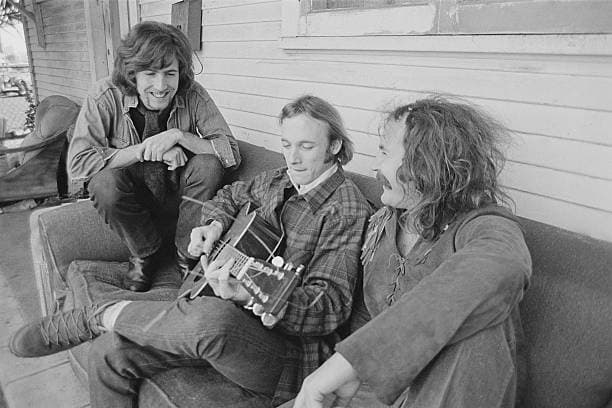
The stage for this pivotal scene was set in the intimate, bohemian confines of Laurel Canyon, specifically at a party at either Joni Mitchell’s or Cass Elliot’s home in 1968. Stills and Crosby were sitting together, trying out an acoustic guitar progression that would become “You Don’t Have to Cry.” Stills took the first vocal line, and Crosby, without any planning or practice, dropped in the harmony—a sound of almost eerie, pre-ordained symmetry. Then, Graham Nash, standing nearby—and contemplating leaving The Hollies back in Britain—heard the two of them and was utterly transfixed. He asked them to play it again. On the second run-through, Nash added a third vocal part, the high, sweet keystone that locked the entire structure into place. The resultant harmony was so pure, so resonant, that the three of them—as different as night and day—knew, instantaneously, that they had created a new, intoxicating sound. This sublime moment of synergy was the birth of Crosby, Stills & Nash.
The meaning of “You Don’t Have to Cry,” written by Stills, is one of quiet, compassionate comfort. It speaks to the universal struggle of finding stability after personal upheaval: “When you hear that sad, sad sound / In your heart, you feel that same old fear…” It’s a beautifully succinct narrative about a relationship surviving a moment of shared anxiety. Yet, the song’s transcendent power lies less in its lyrics than in its vocal arrangement. The intertwining harmonies—Stills’ earthy foundation, Crosby’s mid-range warmth, and Nash’s celestial high notes—elevate a simple folk tune into an almost spiritual experience. For us who first heard it on vinyl, the sheer cleanliness of the acoustic sound, recorded with meticulous care, felt like a breath of fresh, Californian air washing away the psychedelic murk of the late sixties. It was a promise: that even in the face of heartbreak, political chaos, and personal uncertainty, there was still a place where everything fit perfectly, if only for the length of a song. “You Don’t Have to Cry” is the four-minute argument for hope, delivered by three magnificent voices.