
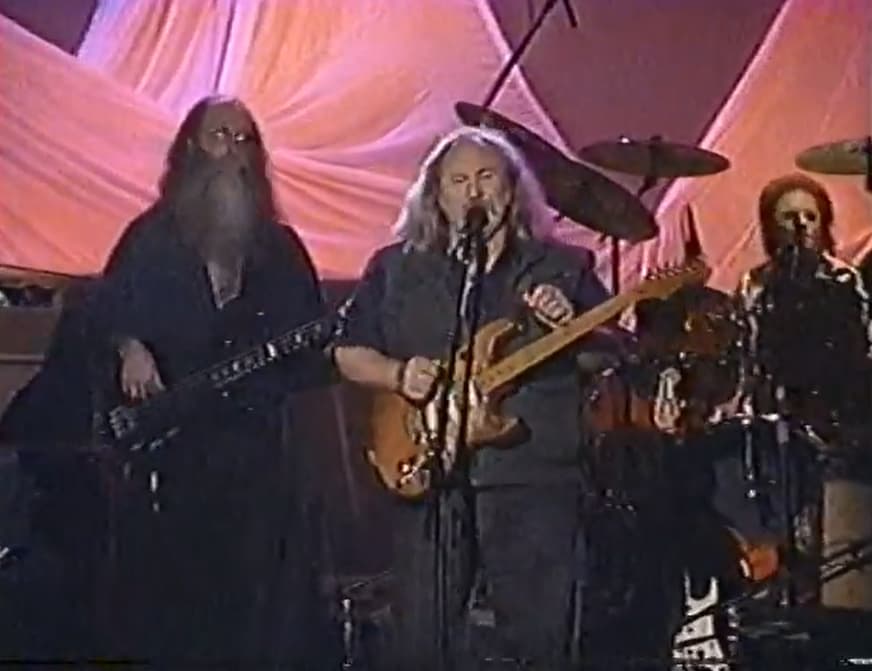
David Crosby and David Lindley on Late Night TV, February 7, 1989
The late night television performance by David Crosby and David Lindley, broadcast on February 7, 1989, stands today as a quietly remarkable document of two master musicians meeting in a setting that prized atmosphere over spectacle. In an era when television performances were often compressed and promotional, this appearance allowed space for nuance, tone, and genuine musical conversation.
David Crosby arrived at this moment as a veteran voice of American music, carrying decades of songwriting, harmony work, and cultural weight from his work with the Byrds and Crosby, Stills and Nash. David Lindley, by contrast, was the consummate musical polymath, renowned for his expressive slide guitar, mastery of world instruments, and his uncanny ability to elevate any song he touched. Together, they formed a pairing rooted not in flash, but in trust and intuition.
What makes this performance especially compelling is its restraint. Lindley’s playing never overwhelms the song. Instead, it listens, responds, and colors the emotional edges of Crosby’s vocal delivery. Crosby, in turn, sings with a reflective calm that suggests an artist fully aware of his history and comfortable within it. The late night studio setting amplifies this intimacy, drawing the viewer into a moment that feels closer to a private session than a broadcast event.
This appearance also gains added value when viewed alongside other archival performances preserved by the BetaGems channel, including the November 15, 1989 episode of Night Music featuring Curtis Mayfield, David Lindley, and George Duke, as well as the 1997 television reunion of Crosby, Stills and Nash with Tom Petty. Together, these recordings form a loose but meaningful archive of artists interacting at a high level, free from commercial urgency.
The February 7, 1989 performance is not remembered for volume or spectacle. Its lasting power lies in its honesty. It captures two musicians who understood that the most enduring moments on stage often come from listening as much as playing. In that sense, this late night appearance remains a small but valuable piece of American music history, one that rewards careful viewing and repeated listening.