
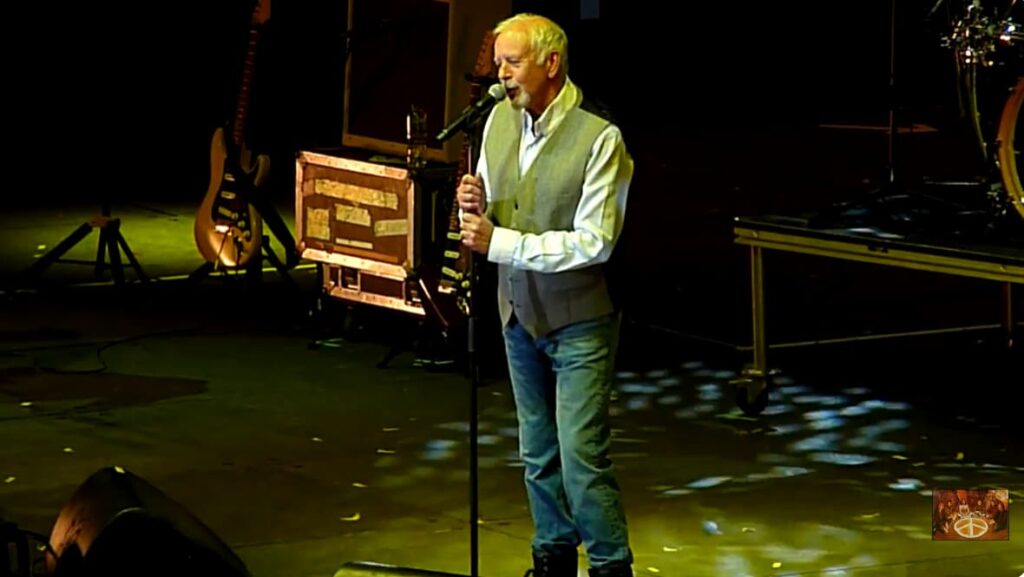
A Hit That Refused to Fade: David Essex Brings “Hold Me Close” Back to Wembley
The moment carried a weight that went far beyond a routine live performance. The show was part of the Legends Live tour, a format designed to reunite artists whose peak years had defined the charts decades earlier. It was not about launching new material. It was about revisiting songs that had endured.
Among them, “Hold Me Close” stood out.
Released in 1975, the song had reached number one in the United Kingdom and became one of Essex’s defining hits. More than forty years later, its return to Wembley created a direct bridge between two eras. The audience in attendance was not discovering the track for the first time. Many had lived through its original success. That shared history shaped the performance before a single note was played.
There is a noticeable absence of theatrical buildup. Essex does not present the song as a centerpiece that demands attention. Instead, he moves into it with the ease of someone revisiting a familiar place. This approach subtly reframes the moment. The performance does not attempt to recreate 1975. It acknowledges the distance from it.
The most striking element comes from the audience itself. As the chorus begins, the crowd responds almost instinctively, singing along in near unison. It is not prompted or exaggerated. It happens because the song no longer belongs solely to the artist. Over time, it has become part of a collective memory. The voices rising from the arena are not simply supporting the performance. They are completing it.
This interaction highlights a deeper connection between the song and the occasion. “Hold Me Close,” originally framed as a love song, takes on a broader meaning in this setting. Performed decades after its release, in front of listeners who have aged alongside it, the title begins to resonate differently. It feels less like a romantic plea and more like an attempt to hold onto something intangible. A moment, a feeling, a time that cannot be repeated.
Essex’s delivery reflects that shift. He does not push his voice to match the energy of earlier recordings. Instead, he allows it to carry the texture of time. The result is not flawless in a technical sense, but it is grounded and credible. There is no effort to disguise the years. That honesty becomes part of the performance’s appeal.
As the song concludes, there is no dramatic finale. The energy settles rather than peaks. Yet the atmosphere in the arena remains warm, sustained by recognition rather than spectacle.
In the end, what makes this performance notable is not its scale, but its perspective. It captures an artist and an audience meeting again across decades, connected by a song that has outlived its original moment and found a new one without needing to change at all.