
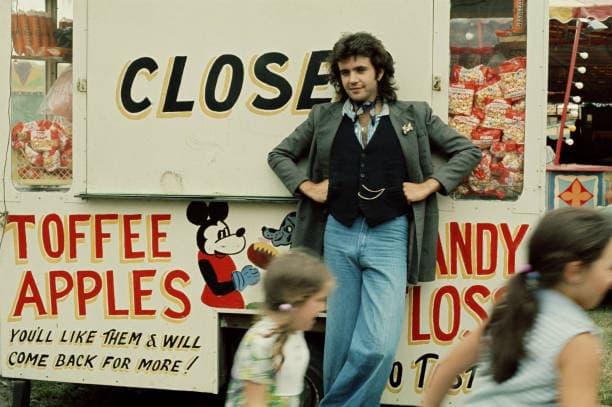
A Stark, Cinematic Glimpse into Urban Despair, a Haunting Reminder of the Bleak Realities Beyond the Glamour.
In the early 1970s, David Essex was a bona fide teen idol, a handsome, charismatic figure who had already conquered the stage in the musical Godspell and was on the cusp of an explosive music career. His 1973 debut album, the aptly titled Rock On, was a masterpiece of atmospheric, mood-driven rock and roll that immediately set him apart. While the title track soared to the top of the charts, becoming a timeless classic that defined an era with its minimalist, thundering bassline and iconic lyrics, the album held a darker, more haunting gem that captured a different, more somber side of his artistry. That song was “Streetfight”. It was not a single, nor did it ever chart on its own; it was a deeply cinematic album cut that served as a stark and powerful counterpoint to the album’s pop sensibilities.
Rock On itself was a massive commercial success, reaching number seven on the UK Albums Chart and earning a silver certification. Its title track, produced by the legendary Jeff Wayne, was a global phenomenon, reaching number 3 in the UK and number 5 on the Billboard Hot 100 in the U.S. This widespread success gave Essex and Wayne the creative freedom to explore more unconventional sounds on the album, and “Streetfight” is a prime example of their collaborative risk-taking. The song’s lack of chart position is a testament to its artistic rather than commercial intent; it was a piece of the puzzle, a crucial part of the album’s emotional landscape.
The story behind “Streetfight” is rooted in the urban grit of 1970s Britain, a stark reality far removed from the polished sheen of pop stardom. The lyrics paint a bleak picture of an “Another Saturday night” where violence is an inescapable part of the backdrop. The haunting refrain, “Somebody in a streetfight / Got shot tonight,” is delivered with a chilling nonchalance that speaks to a numbing familiarity with despair. The song’s lyrical genius lies in its stark observation, devoid of judgment. It’s a snapshot of a moment, a memory of a time when the post-war innocence had faded and a harder edge had taken hold of the cities. David Essex has spoken about his connection to these working-class narratives, and with “Streetfight,” he channeled that authenticity into a soundscape that was both unsettling and deeply moving.
For those who lived through that era, the song resonates with a powerful sense of nostalgia—not for a moment of joy, but for a moment of shared reality. The production, a masterwork by Jeff Wayne, is a key part of its appeal. The song is a tapestry of sounds: a wailing saxophone, a repetitive, insistent drum beat, and a distorted guitar riff that feels like a warning siren. It’s a sound that seems to mimic the chaos and tension of the urban environment it describes. The song’s most iconic element, a whispered, cyclical line—”I was lookin’ back to see / If you were lookin’ back at me / To see me lookin’ back at you / What?! I saw that you were lookin’ too”—was famously sampled decades later by Massive Attack, cementing its place in musical history. “Streetfight” is a reminder that some of the most powerful art is not always the most popular. It is a brooding, cinematic piece that encapsulates the anxieties of its time and remains a hauntingly beautiful listen, a somber echo from a grittier past.