
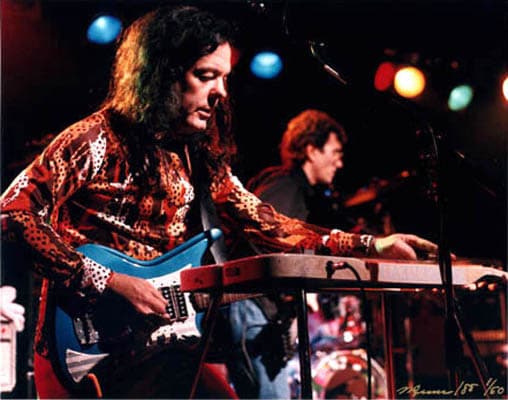
A Joyful Invocation of Rhythm, Heritage, and One Man’s Command of the Room
When David Lindley performed “Bon Temps Rouler” on Sunday Night Live in 1989, it was not tied to a charting single or a contemporary studio album, but it resonated with an authority earned through decades of musical exploration. By that time, Lindley was already revered as one of American music’s great polymaths, a master of stringed instruments whose reputation had been forged through his solo work and his long collaboration with Jackson Browne. This Hi Fi mono broadcast captured him alone on stage, stripped of ensemble support, relying solely on voice, rhythm, and instinct, and proving that presence can outweigh production every time.
“Bon Temps Rouler” is a song with deep roots, a traditional Creole and rhythm and blues standard whose title translates loosely to let the good times roll. In Lindley’s hands, it becomes more than a festive refrain. It transforms into a living conversation with American musical history. Performing solo, he collapses the distance between blues, Cajun tradition, New Orleans swagger, and West Coast eclecticism. There is no sense of revivalism here. This is not an academic exercise. Lindley inhabits the song as something current and alive, breathing fresh urgency into a piece shaped long before the television lights were switched on.
Musically, the performance is a study in control and freedom existing side by side. Lindley’s right hand becomes a percussion section, driving the groove forward with relentless precision, while his left hand colors the harmony with subtle inflections that hint at multiple traditions at once. His voice, never conventionally polished, carries the authority of experience. It bends around the melody, playful one moment and commanding the next, drawing the listener into a space where celebration and storytelling are inseparable. The mono sound only enhances the effect. Nothing distracts from the core of the performance. It feels immediate, almost tactile, as if Lindley is playing in the same room rather than through a broadcast signal.
Emotionally, this rendition of “Bon Temps Rouler” radiates joy without frivolity. Lindley does not perform happiness as an act. He channels it as a shared human condition, earned through survival, memory, and communal release. There is humor in his delivery, but also wisdom. This is a man who understands that music is not about spectacle but about connection. His solo approach emphasizes that truth, reminding the listener that a single musician, when fully present, can summon an entire world of sound and feeling.
Within Lindley’s broader legacy, this performance stands as a distilled example of his artistry. Known for moving effortlessly between genres and instruments, he always placed feel above formality. On this 1989 stage, he demonstrates that mastery is not about excess but about trust in the song and in oneself. “Bon Temps Rouler” becomes a vessel for that philosophy, a declaration that good times are not manufactured, they are invoked through honesty and groove.
Seen today, this performance feels timeless. It is not bound to trends or production eras. It is a reminder of what live music can be at its purest, one voice, one instrument, and a deep understanding of where the music comes from and where it needs to go.