
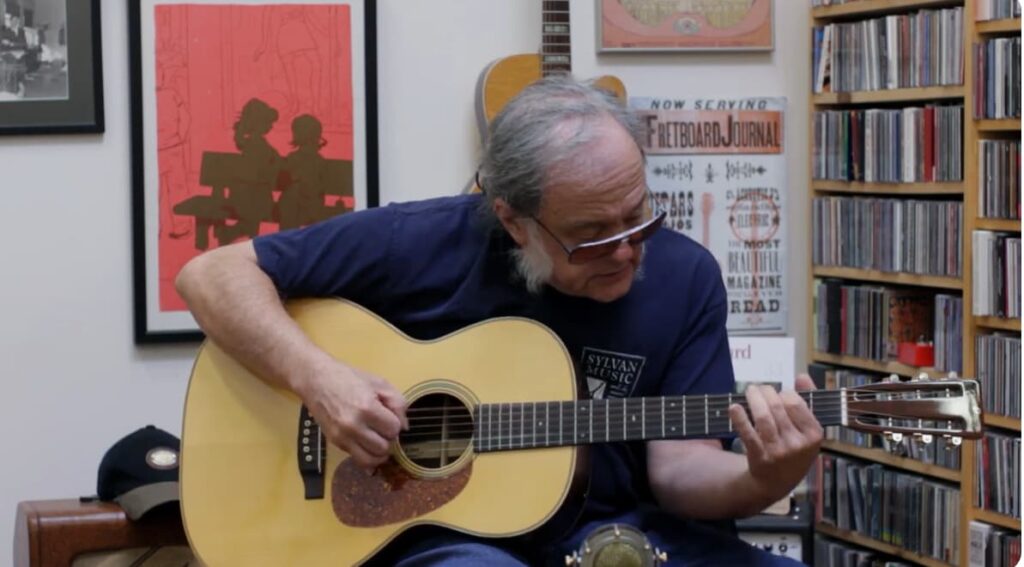
David Lindley’s Unscripted Tribute to Warren Zevon at the Fretboard Journal
In December 2014, the offices of the guitar publication Fretboard Journal witnessed a small but memorable musical moment when renowned multi instrumentalist David Lindley stopped by for a visit. Known among musicians for his extraordinary command of stringed instruments ranging from lap steel and electric guitar to oud and bouzouki, Lindley has long been regarded as one of the most distinctive instrumental voices to emerge from the American roots music scene.
His connection with the magazine was already well established. Lindley had appeared on the cover of Issue 11 in an interview conducted by singer songwriter Ben Harper, and later contributed his own interview in Issue 19 with the late Armenian oud master John Bilezikjian. When he returned to the magazine’s offices in late 2014, the editors decided to create a spontaneous musical moment.
Instead of handing Lindley one of his familiar instruments, they presented him with a guitar he had never played before, a 2010 000 28 style instrument built by celebrated Virginia luthier Wayne Henderson. Henderson’s handmade guitars are admired among acoustic musicians for their craftsmanship and tonal clarity, often inspired by classic prewar American guitar designs.
Faced with the unfamiliar instrument, Lindley responded in the most natural way possible. Without rehearsal, he began performing Indifference of Heaven, a reflective composition written by the late American songwriter Warren Zevon. The song appears on Zevon’s 1995 album Mutineer, a record noted for its sparse arrangements and intimate tone. Unlike many of Zevon’s earlier releases that featured fuller band production, Mutineer often places the songwriter alone with his instruments, allowing the mood and storytelling of the songs to stand at the center.
Lindley’s interpretation in the Fretboard Journal office carries the relaxed authority of a musician deeply familiar with the traditions of American songwriting. Even with a guitar he had never previously encountered, he quickly settles into the instrument, shaping the chords and melody with a fluid and expressive touch.
For many listeners, Lindley remains closely associated with the music of Jackson Browne, whose recordings and live performances in the 1970s prominently featured Lindley’s expressive slide guitar work. Yet his career has always stretched far beyond that collaboration, encompassing world instruments, experimental tunings, and an encyclopedic curiosity about stringed music.
Near the end of the performance, Lindley briefly stumbles in the phrasing of the tune. The moment is minor and even humorous, and the magazine itself acknowledged the small slip when presenting the recording. Rather than diminishing the performance, it reinforces the authenticity of the session. What viewers hear is not a polished studio production but a real musician responding in real time to an unfamiliar instrument and a beloved song.
The resulting video remains a quietly fascinating document of Lindley’s artistry. In a simple office setting, with no rehearsal and no elaborate equipment, he transforms a Warren Zevon composition into an intimate acoustic performance that reflects decades of experience, musical curiosity, and deep respect for the craft of songwriting.