
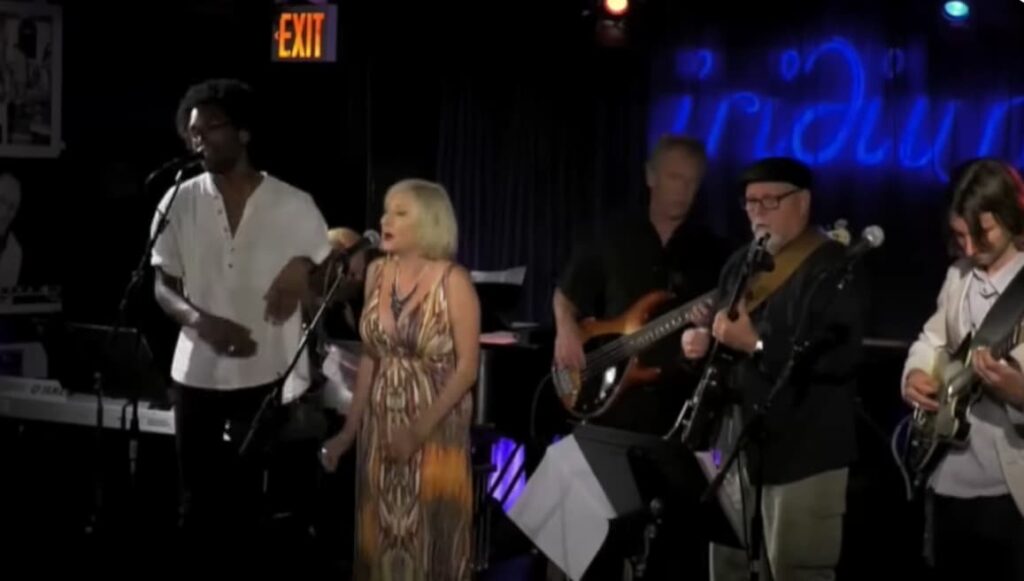
Bodhisattva Revisited: Denny Dias Brings Steely Dan’s Spirit Back to Life at the Iridium, 2015
When Denny Dias, founding member of Steely Dan, stepped onto the stage at New York’s Iridium Jazz Club on August 6, 2015, it was not a nostalgia act. It was a reclamation of musical intent. Performing “Bodhisattva”, one of Steely Dan’s most electrifying early compositions, Dias reminded the audience that this music was never merely about studio perfection, but about sharp instincts, rhythmic tension, and fearless interplay.
“Bodhisattva” has always been a demanding piece. Built on rapid-fire harmonic movement and relentless forward drive, it leaves no room for complacency. In this live setting, Dias approached the song not as a relic from Countdown to Ecstasy, but as a living framework for musicianship. His guitar tone was precise yet relaxed, reflecting the seasoned confidence of a player who helped define the Steely Dan vocabulary long before it became legendary.
What elevated this performance was the ensemble around him. Lisa Jason anchored the band with a vocal presence that balanced control and soul, while Andy Bergsten, Christian Tookes, Joe Cincotta, Scott Adair, Justin Poindexter, and Rusty Smith formed a rhythm and horn foundation that understood the core Steely Dan principle: sophistication must still swing. The groove never rushed, yet it never loosened its grip.
A particularly notable element was Yaron Gershovsky on keyboards, whose role extended far beyond accompaniment. As the longtime music director of The Manhattan Transfer, Gershovsky brought an arranger’s ear and a jazz-first sensibility to the performance. His voicings added color and depth, subtly expanding the harmonic landscape without ever overshadowing the song’s aggressive momentum. It was a reminder that Steely Dan’s music sits at the crossroads of rock, jazz, and disciplined orchestration.
The Iridium, with its intimate setting and acoustically honest room, proved to be the ideal venue. Every accent landed clearly, every rhythmic exchange felt intentional. Dias, often understated in demeanor, let the music speak with authority. His playing emphasized clarity and articulation rather than flash, underscoring why his contributions to Steely Dan’s early sound were so crucial.
This performance of “Bodhisattva” stood as more than a tribute to a classic track. It was evidence that Steely Dan’s legacy is best honored not by imitation, but by musicians who understand its demands and respect its intelligence. In Denny Dias’s hands, the song retained its bite, its wit, and its sense of forward motion.
Nearly four decades after its creation, “Bodhisattva” still challenges players and rewards listeners. On that August night in 2015, it did exactly what great music should do: it lived, breathed, and moved relentlessly forward.