
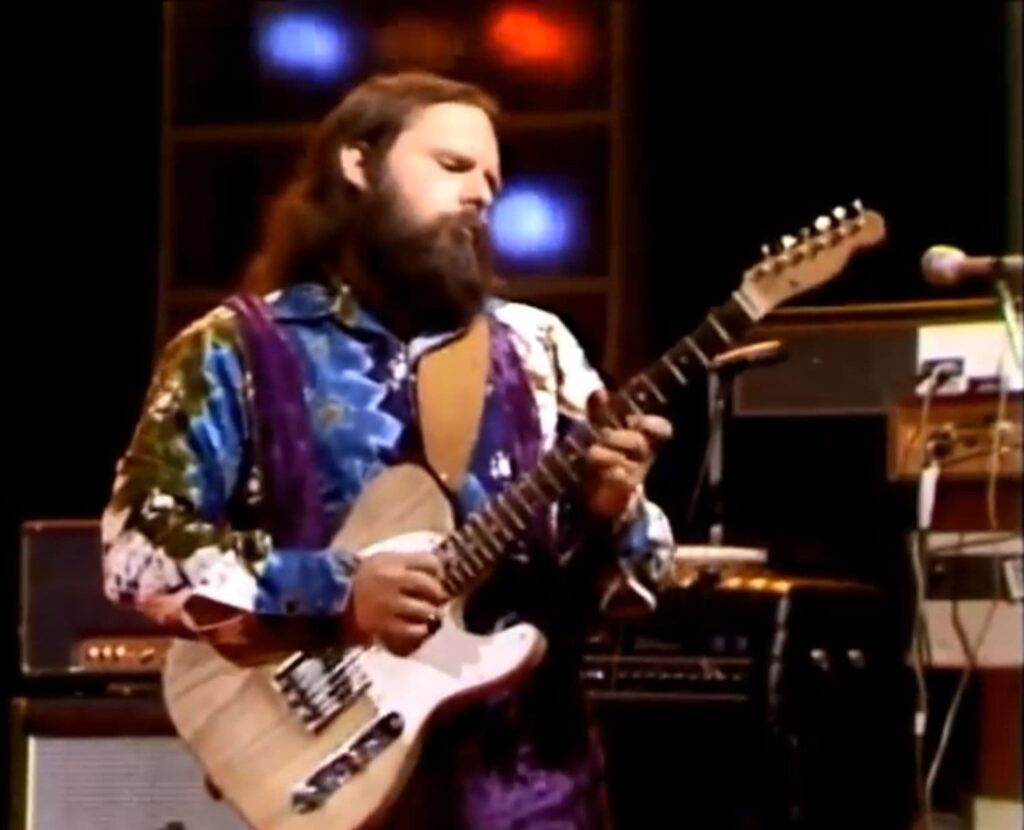
Denny Dias Joins the Hampton Hawes Trio for a Subtle Jazz Statement in San Francisco 1976
The live performance of Fly Me To The Moon recorded on August twenty eight nineteen seventy six at the Great American Music Hall in San Francisco offers a revealing glimpse into a lesser known side of Denny Dias. Best known to the wider public as a founding member and guitarist of Steely Dan, Dias appears here not as a studio architect of complex jazz rock, but as a guest musician stepping respectfully into a straight ahead jazz setting.
The performance features the Hampton Hawes Trio, led by the acclaimed pianist Hampton Hawes, whose career had already left a deep mark on West Coast jazz. Joined by Carol Kaye on electric bass and Al Williams on drums, the group provides a relaxed yet focused framework for the familiar standard. Hawes approaches the piece with lyrical restraint, favoring clarity and swing over virtuoso display, setting the tone for the entire performance.
Denny Dias enters the spotlight during his guitar solo at approximately the seven minute mark. His contribution is modest in scale but rich in musical intent. Rather than pushing technical boundaries or asserting a strong stylistic signature, Dias opts for a melodic and conversational approach. His phrasing reflects a clear debt to the influence of Jim Hall, emphasizing space, tone, and harmonic sensitivity. Each line feels considered, shaped by the rhythm section rather than placed on top of it.
Carol Kaye’s presence on electric bass adds further interest to the performance. Known primarily for her extensive session work in pop and rock recordings, Kaye demonstrates her jazz fluency through a supportive and steady pulse. Her playing remains understated, allowing Hawes and Dias to explore melodic ideas without distraction. Al Williams complements this balance with subtle dynamic control, keeping the groove flexible and attentive.
What makes this recording valuable is not its dramatic impact, but its honesty. Dias does not attempt to redefine the song or dominate the ensemble. Instead, he listens closely, responds thoughtfully, and blends seamlessly into the trio’s established language. This restraint stands in contrast to the highly polished and layered work he was producing with Steely Dan during the same period, highlighting his versatility as a musician.
Recorded in an intimate venue known for its attentive audiences and excellent acoustics, the performance captures a moment of quiet musical exchange rather than spectacle. Fly Me To The Moon serves as a shared platform for seasoned players who understand the strength of simplicity.
In retrospect, this San Francisco performance remains a subtle but meaningful document. It shows Denny Dias engaging directly with the jazz tradition, not as a guest star seeking attention, but as a guitarist comfortable speaking softly and clearly within a respected musical conversation.