
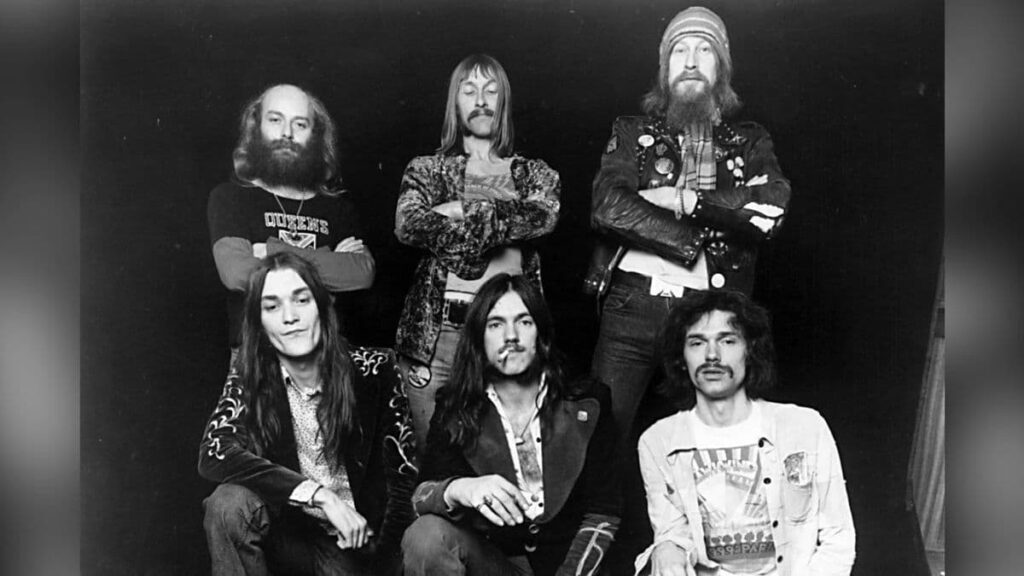
A primal and relentless sonic assault, “Motorhead” became the snarling, speed-fueled anthem that christened and defined Lemmy Kilmister’s legendary band.
While the song “Motorhead” is undeniably the signature track of the band Motörhead, its origins lie firmly within the psychedelic and proto-punk soundscape of Hawkwind. Released as the B-side to their 1974 single “Kings of Speed,” “Motorhead” was one of Lemmy Kilmister’s final contributions to Hawkwind before his acrimonious departure and subsequent formation of his own iconic band, which he fittingly named after this very song. Even in its original Hawkwind incarnation, the track possessed a raw, aggressive energy that hinted at the louder, faster, and more uncompromising sound Lemmy would later pioneer.
The story behind “Motorhead” within the context of Hawkwind is one of burgeoning frustration and a clash of musical visions. Lemmy, who played bass and occasionally sang for Hawkwind, had a penchant for a harder, more straightforward rock sound that often butted heads with the band’s more spacey and experimental tendencies. “Motorhead” was a direct expression of this raw energy, a stripped-down blast of speed and volume that stood apart from much of Hawkwind’s more ethereal material. The lyrics, penned by Lemmy, are simple and direct, celebrating the thrill of speed and the rebellious spirit of the road. Even in this early form, his distinctive snarl and the song’s relentless drive were unmistakable indicators of the musical path he was itching to forge.
The meaning of “Motorhead” in its Hawkwind guise, while perhaps not fully formed into the defiant anthem it would later become for Lemmy’s own band, still embodies a primal urge for speed, freedom, and a rejection of constraints. The repetitive, almost mantra-like lyrics and the driving, no-nonsense musicality evoke a sense of pure, unadulterated energy. It’s a song about the visceral thrill of movement and the escape it provides. Even without the full force of the later Motörhead lineup, the raw aggression and the celebration of a powerful, almost mechanical force are palpable. It’s a glimpse into the musical DNA that Lemmy would soon fully unleash.
For those familiar with both Hawkwind’s psychedelic explorations and Motörhead’s thunderous onslaught, hearing the original Hawkwind version of “Motorhead” is a fascinating study in musical evolution. It’s a raw and potent precursor to a sound that would become legendary. While perhaps lacking the full sonic weight and intensity of Motörhead’s definitive rendition, this early version nonetheless crackles with Lemmy’s unmistakable energy and the nascent spirit of rebellion that would define his future band. It stands as a crucial link in the history of heavy music, a testament to the power of a singular musical vision finding its ultimate and iconic outlet. It’s the sound of a motor revving, ready to break free and carve its own thunderous path.