
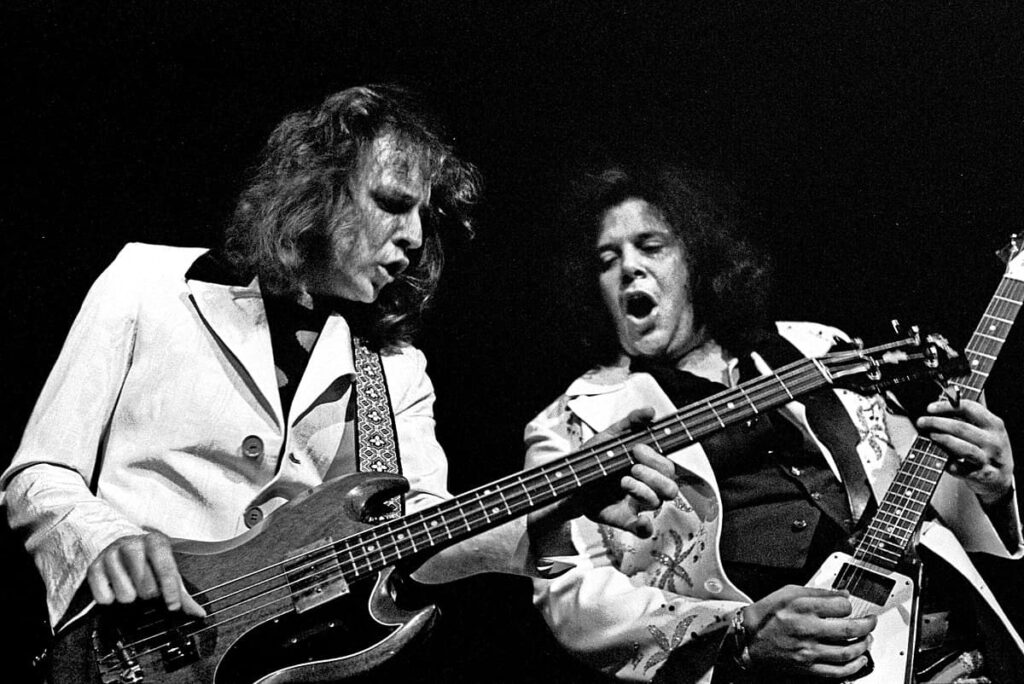
A quiet elegy wrapped in soaring melody, written for wounds time could never fully close
The performance of “Theme for an Imaginary Western” featuring Jack Bruce and Leslie West stands as one of those rare intersections in rock history where memory, loss and musical brotherhood fuse into something almost sacred. The version associated with their later collaboration emerged from a reunion that sparked unexpectedly during a 1988 Howard Stern broadcast, where Bruce performed from England while West played live in New York. The energy and emotional weight of that moment pushed them to record together again, resulting in the rare album often referred to simply as Theme, a work shaped by reflection rather than commercial ambition.
Originally written by Jack Bruce, the song predates its most famous interpretation. Although first released on Bruce’s 1969 album Songs for a Tailor, it became widely known when Mountain recorded it shortly afterward. Bruce considered this composition the finest he ever created. The track’s history is also tied to disagreement and taste, as Eric Clapton reportedly struggled to connect with it during their Cream years while Leslie West embraced it with deep conviction. That artistic alignment is what allowed the song to find its true home not in the charts but in the hearts of musicians who understood its emotional and musical architecture.
Lyrically, the song operates like a poetic frontier vision. It evokes images of travel, passage and unanswered longing. The title itself feels symbolic, as if the West it describes never existed on any map but instead belonged to memory, regret and hope. It carries the emotional cadence of a farewell, yet it never collapses into despair. Instead, it reflects the stoic dignity of a journey carried forward despite loss.
When Jack Bruce later performed and recorded the song in tribute to Felix Pappalardi, producer of Cream and bassist for Mountain who helped shape the song’s early legacy, its meaning deepened. What began as an abstract meditation evolved into a personal lament. The notes sound heavier, almost reverent, as though each phrase carries the weight of shared history, fractured friendships and unfinished conversations.
Leslie West’s guitar tone in this version is unmistakable. Thick, resonant, raw but melodic, it functions not as accompaniment but as dialogue with Bruce’s voice. There is no rush, no unnecessary embellishment. Instead, there is space. Space for memory. Space for grief. Space for gratitude.
Today, “Theme for an Imaginary Western” stands as one of those rare compositions whose emotional power grows with time. It contains the sound of something deeply human: the knowledge that some people shape us forever, even long after they are gone.