
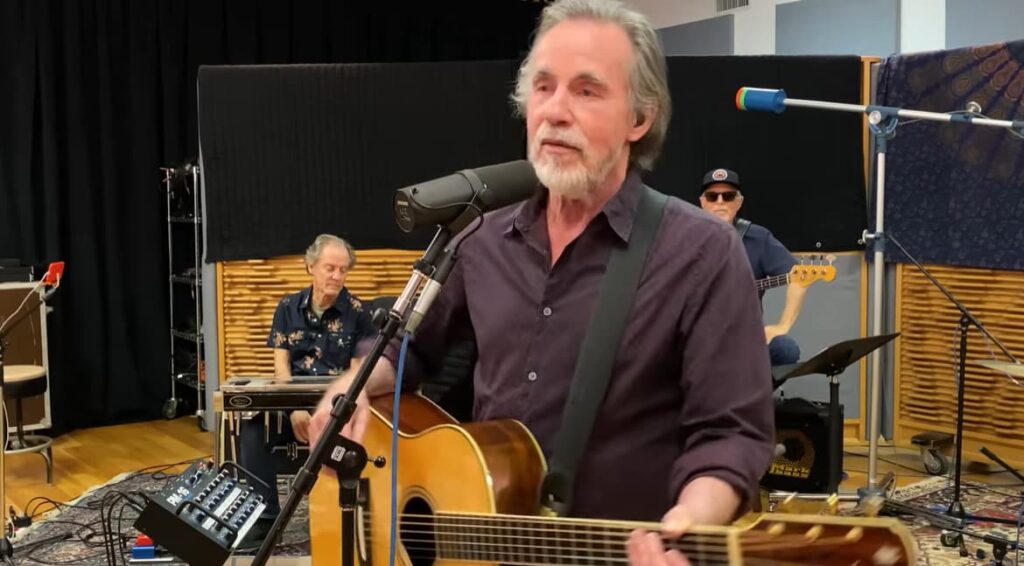
Jackson Browne Revisits A Child in These Hills in an Intimate 2021 Studio Performance
During the 2021 Dream Concert, Jackson Browne delivered a quietly compelling studio performance of A Child in These Hills, offering a fresh and deeply focused interpretation of one of his more introspective songs. Filmed and recorded in a controlled studio environment rather than on a large stage, the performance emphasized listening, restraint, and emotional clarity, qualities that have long defined Browne’s work.
Joined by a seasoned group of collaborators, Browne was supported by Greg Leisz on pedal steel and slide guitar, Val McCallum on electric guitar, Jeff Young on keyboards, Bob Glaub on bass, and Mauricio Lewak on drums. This lineup reflected a band built on trust and shared musical language. Each player understood when to step forward and when to leave space, allowing the song’s mood to unfold naturally.
A Child in These Hills is not among Browne’s most widely known songs, yet it carries many of the themes that define his songwriting. It explores solitude, searching, and the tension between vulnerability and self awareness. In the Dream Concert performance, Browne approached the song with calm authority, delivering the vocal without embellishment. His phrasing was deliberate and measured, suggesting reflection rather than nostalgia.
The arrangement remained understated. Greg Leisz added subtle color through sustained tones and gentle melodic responses, while Val McCallum’s guitar work stayed restrained, focused more on texture than lead lines. Jeff Young’s keyboards provided warmth and depth without drawing attention away from the vocal. The rhythm section of Glaub and Lewak maintained a steady and unforced pulse, giving the performance a grounded and unhurried feel.
What distinguished this rendition was not reinvention, but concentration. The studio setting allowed every detail to be heard clearly, from Browne’s breath between lines to the quiet interplay among the instruments. Rather than reaching for dramatic peaks, the performance relied on consistency and tone, drawing the listener inward.
The Dream Concert itself was presented as part of a broader initiative connected to cultural awareness and support, adding context to the performance without overshadowing it. Browne did not frame the song with speeches or explanations. Instead, he let the music speak for itself, trusting the audience to meet it on its own terms.
This performance of A Child in These Hills stands as a strong example of Jackson Browne’s enduring approach to live music. It shows an artist who understands the value of simplicity, collaboration, and emotional honesty. In an era often driven by spectacle, the Dream Concert version offers something rarer, a moment of stillness shaped by experience and intention.