
When Voices of Conscience Converge on One Stage
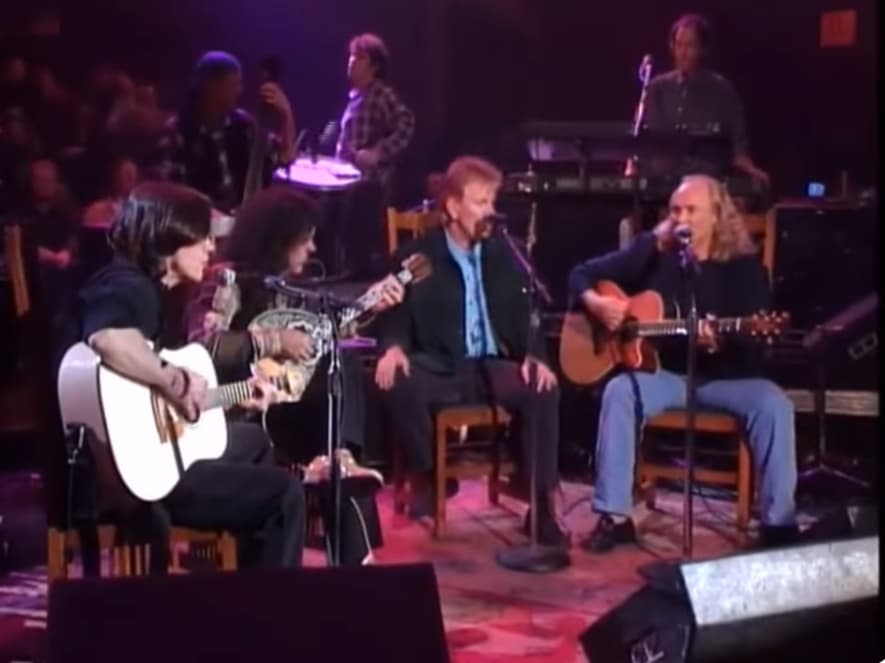
In a performance that feels less like entertainment and more like testimony, Jackson Browne is joined by David Crosby, Graham Nash, and David Lindley for a powerful rendition of “Lives in the Balance.” The result is a moment that transcends performance, capturing the uneasy intersection between music and moral responsibility.
Originally released in the mid 1980s, the song emerged from a period marked by political tension and global uncertainty. Yet in this live setting, its relevance feels undiminished. The arrangement retains its hypnotic pulse, built on a rhythmic foundation that carries an almost ritualistic quality. It does not rush forward. It advances deliberately, allowing each line to settle with weight.
What distinguishes this performance is the presence of multiple voices bound by a shared history. Crosby and Nash bring with them the legacy of an earlier generation of protest music, their harmonies instantly recognizable yet carrying a deeper resonance here. When their voices blend with Browne’s, the effect is not ornamental. It is reinforcing. The message gains dimension, as though it is being affirmed from several directions at once.
David Lindley’s contribution anchors the sound in something more organic. His playing avoids excess, instead shaping the atmosphere with precision and restraint. The instrumentation never overwhelms the message. It frames it. This balance between sound and meaning is what gives the performance its quiet intensity.
There is a notable absence of theatricality. No attempt is made to dramatize the material beyond what it already contains. The stage becomes a space of focus rather than spectacle. This choice proves effective. It invites the audience to listen more closely, to engage with the content rather than react to presentation.
As the song unfolds, the emotional impact builds not through volume but through accumulation. Each verse adds another layer, another perspective, until the performance reaches a point where silence feels as significant as sound. The conclusion does not seek applause. It leaves a question hanging, unresolved and deliberate.
Viewed in retrospect, this collaboration stands as a reminder of what music can achieve when it moves beyond form. “Lives in the Balance” is not simply performed. It is delivered, carried by voices that understand the weight of what they are saying.