
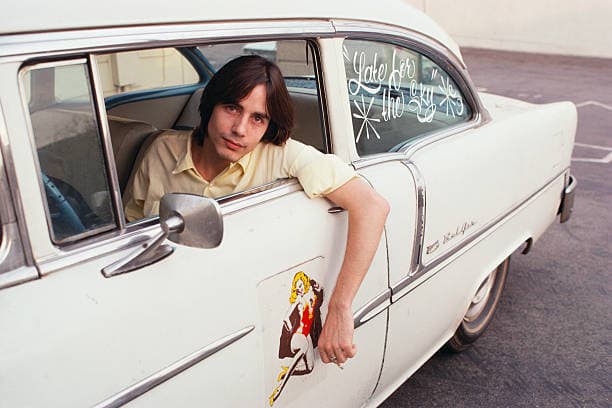
A Poignant and Weary Confession of Disillusionment, a Sobering Elegy for a Fading Era of Hope and Ideals.
By 1973, the world had changed. The bright, idealistic optimism of the 1960s had faded into the complex and often cynical reality of the new decade. For Jackson Browne, a singer-songwriter who had emerged as a voice of his generation, this transition was a profound and deeply personal drama. He had experienced a measure of fame with his debut album, but the world he was now writing about was a different place, marked by environmental anxieties and political corruption. His sophomore album, a somber and powerful reflection on these times, was titled For Everyman. It reached a respectable number 43 on the Billboard 200, but its true power lay not in its commercial success, but in its ability to capture the collective weariness of a generation. The album’s title track, “For Everyman,” was never a single and never found its way onto the pop charts, a fact that only deepens its allure as a cherished, intimate masterpiece. Its drama is found in its profound lyrical narrative—a haunting and honest look at the loss of innocence and the weight of a generation’s burden.
The story behind “For Everyman” is a deeply personal, dramatic counterpoint to the folk anthems that preceded it. It was a direct response to a song that had already become a touchstone for the generation: Joni Mitchell’s “The Circle Game.” That song spoke of the innocence of youth and the bittersweet inevitability of growing older. Jackson Browne’s song, however, is a more grounded, and perhaps more painful, continuation of that story. It’s a theatrical monologue from a narrator who has seen the promise of the 60s turn into the difficult realities of the 70s. The drama is the internal conflict of an idealist who is struggling to hold onto his hope in the face of widespread disillusionment. The song’s opening lines, which reference both a father who has given up on his dreams and a son who is still naive, immediately set a tragic and universal scene.
The lyrical drama of the song is a powerful statement on responsibility and the passage of time. The protagonist, the “everyman,” is both a specific character and a stand-in for all of us. He is grappling with the difficult legacy of a world in chaos, a world polluted both physically and morally. The song is a plea for his generation to not give up, to not surrender to the cynicism that surrounds them. The music itself is a character in this drama, perfectly amplifying the sense of weary but heartfelt emotion. The gentle, acoustic-based melody and the soaring, emotional harmonies are a perfect vehicle for the song’s message. The music builds with a sense of quiet urgency, as if the narrator is trying to make a final, desperate plea before it’s too late. The pedal steel guitar adds a layer of country-tinged melancholy that deepens the song’s emotional resonance, a sound of a profound sadness that is almost unbearable.
For those of us who came of age with this music, “For Everyman” is more than just a song; it’s a historical document. It takes us back to a time when the world felt like it was falling apart, but music offered a way to make sense of it all. It’s a nostalgic reminder of the hopes and struggles of a generation that was forced to grow up too fast. The song’s enduring power lies in its ability to speak to a deeper human truth—that the burden of responsibility is heavy, but it’s a burden that belongs to every one of us. It stands as a timeless and deeply emotional piece of music, a haunting and cinematic fable that continues to resonate with its profound human drama.