
A shared benediction of love, loss, and brotherhood carried on voices that understand the road
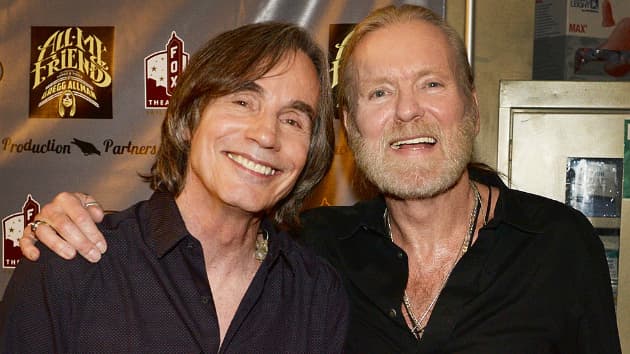
Originally released by The Allman Brothers Band in 1972, “Melissa” became one of the group’s most enduring songs, reaching the Top 20 of the Billboard Hot 100 and anchoring the emotional core of the double album Eat a Peach. Written by Gregg Allman, the song long outlived its chart success, evolving into a quiet hymn for restless souls and traveling hearts. On Friday, January 10, 2014, that hymn took on renewed meaning when Jackson Browne joined Gregg Allman on stage to perform “Melissa” during All My Friends: Celebrating the Songs and Voice of Gregg Allman, a tribute concert held at the Fox Theatre in Atlanta, Georgia.
By the time of this performance, “Melissa” had already become inseparable from Allman’s identity as a songwriter. Unlike the fiery improvisations and blues driven thunder that defined much of the Allman Brothers Band’s sound, this song was introspective, tender, and deeply personal. Its gentle acoustic foundation and reflective lyrics revealed Allman’s softer instincts, his longing for connection amid a life shaped by movement, distance, and impermanence. It was a song about choosing love even when the road keeps calling, about recognizing what truly matters when everything else feels transient.
The pairing of Jackson Browne and Gregg Allman for this performance carried profound emotional weight. Browne, himself a master chronicler of life on the road, brought a quiet reverence to the moment. His voice did not compete with Allman’s but instead wrapped around it, offering harmony that felt earned through shared experience rather than rehearsal. This was not a duet designed to impress, but a conversation between two artists who understood the costs and comforts of devotion, music, and time.
In the context of the tribute concert, the performance stood as a moment of stillness amid celebration. The Fox Theatre became a place of collective reflection, where friends, fellow musicians, and admirers gathered not to mythologize Gregg Allman, but to honor the humanity within his work. “Melissa” resonated as a song that had always resisted spectacle. Its power lay in restraint, in the way it allowed vulnerability to speak louder than bravado.
Lyrically, the song remains timeless because it avoids grand declarations. Instead, it speaks in quiet truths, acknowledging distance without resentment and love without possession. That balance between freedom and devotion is what gave the song its lasting cultural resonance. In 2014, hearing Allman sing it alongside Browne felt like a full circle moment, as if the road had finally slowed enough to allow reflection without regret.
This performance of “Melissa” was not merely a highlight of the evening. It was a reminder of why Gregg Allman’s songwriting endures. It speaks to anyone who has loved deeply while knowing they could not always stay, and to anyone who understands that the most powerful songs are often the ones that whisper rather than shout.