
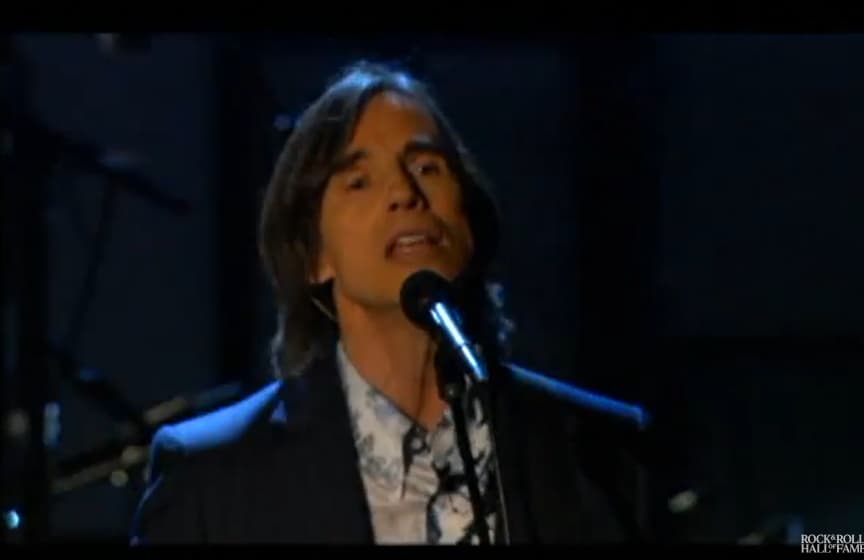
Jackson Browne at the 2004 Rock and Roll Hall of Fame Inductions: Songs of Conscience and the Open Road
Jackson Browne’s appearance at the Rock and Roll Hall of Fame Induction Ceremony in 2004 was a defining moment that reflected not only his musical legacy, but also the deeper values that have shaped his career. On a night dedicated to honoring rock history, Browne chose to perform two of his most enduring and thematically powerful songs, “The Pretender” and “Running on Empty.” Together, they captured the full emotional and philosophical arc of his work.
Opening with “The Pretender,” Browne delivered a performance that felt especially resonant in the Hall of Fame setting. Released in 1976, the song is widely regarded as one of his most incisive statements on modern life, questioning conformity, material ambition, and the quiet compromises people make as they move through adulthood. On stage in 2004, the song sounded less like a product of the 1970s and more like a timeless reflection on identity and purpose. Its presence at the ceremony underscored why Browne has long been viewed as a songwriter who looks beyond success and asks uncomfortable, necessary questions.
He then followed with “Running on Empty,” the title track from his landmark 1977 album. Unlike the introspective tension of “The Pretender,” this song celebrates movement, endurance, and life lived on the road. It has become one of the most recognizable anthems about touring, exhaustion, and the quiet resilience of musicians who keep going night after night. Performed at the Rock and Roll Hall of Fame, it took on a broader meaning, standing as a tribute to all artists whose careers were built through constant travel, dedication, and sacrifice.
The significance of Jackson Browne’s appearance went far beyond the songs themselves. In 2004, he was not simply a guest performer. He was also being recognized as a major figure in American rock songwriting. His induction acknowledged decades of work that bridged personal storytelling and social awareness, influencing countless artists across generations. Browne helped define the West Coast singer songwriter movement, yet his music consistently reached beyond geography, speaking to universal experiences of doubt, hope, fatigue, and renewal.
On a stage filled with legends, Jackson Browne’s performance stood out for its restraint and sincerity. There were no grand gestures or theatrics, only songs delivered with clarity and conviction. In doing so, he reminded the audience that rock and roll’s greatest power often lies not in volume or spectacle, but in honesty.
His 2004 Rock and Roll Hall of Fame appearance remains a powerful reminder of why his songs endure. They continue to resonate because they speak quietly, directly, and truthfully to the lives people recognize as their own.