
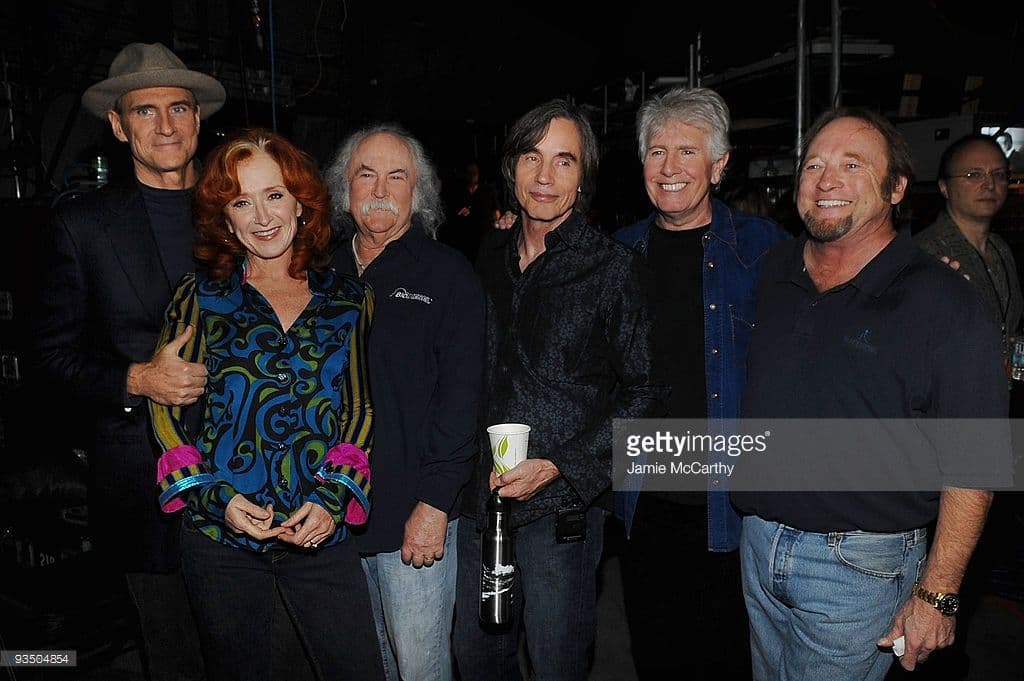
A Moment of Quiet Reckoning Shared Among Old Friends and a Lifetime of Songs
When Jackson Browne stepped onto the stage at Madison Square Garden on October 29 and 30, 2009, joining forces with Crosby, Stills and Nash for “The Pretender”, the performance became one of the most emotionally resonant moments of the 25th Anniversary Rock and Roll Hall of Fame Concert. The song itself, originally released in 1976 as the title track of The Pretender, had been a major commercial and artistic milestone for Browne, reaching the Top 40 on the Billboard Hot 100 and cementing his reputation as one of the most introspective voices of the singer songwriter era. More than three decades later, it returned not as a hit single chasing charts, but as a lived confession, deepened by time, friendship, and shared history.
From its opening lines, “The Pretender” has always been about the quiet compromises of adulthood, the slow erosion of youthful idealism under the weight of routine, responsibility, and social expectation. In the context of this Hall of Fame celebration, the song took on an added gravity. Browne was no longer the young observer chronicling the future from a distance. He was standing inside that future, singing from lived experience, his voice weathered but resolute. The presence of Crosby, Stills and Nash transformed the song from a solitary meditation into a communal reckoning.
Musically, the performance is restrained, almost reverent. The familiar piano figure remains the emotional anchor, while the harmonies of Crosby, Stills and Nash rise gently around Browne, not overpowering him but reinforcing the song’s sense of shared understanding. Their voices, each carrying decades of triumph and turbulence, add layers of meaning to every phrase. This is no longer just Browne’s story. It becomes a collective reflection on aging, survival, and the cost of staying true in an unforgiving world.
What makes this rendition particularly powerful is its emotional honesty. There is no attempt to dramatize or modernize the song. Instead, it unfolds with quiet dignity, allowing its words to resonate naturally. The audience response at Madison Square Garden reflects this. Rather than explosive applause, there is attentive silence, the kind reserved for moments that feel personal even in a massive arena. It is the sound of thousands recognizing themselves in the song’s questions.
Within the broader narrative of the Rock and Roll Hall of Fame celebration, this performance stands apart. While many artists used the occasion to relive their most exuberant triumphs, Browne chose introspection. “The Pretender” reminded everyone present that rock music’s greatest power often lies not in rebellion or spectacle, but in reflection and truth. It reaffirmed Browne’s place not only as a chronicler of his generation, but as one of its most enduring moral voices.
Seen through the lens of time, this Madison Square Garden performance feels like a summation. Jackson Browne, supported by Crosby, Stills and Nash, offered a song that has grown older alongside its listeners, gaining depth rather than losing relevance. It stands as a testament to music that does not age out of meaning, but grows heavier, wiser, and more necessary with every passing year.