
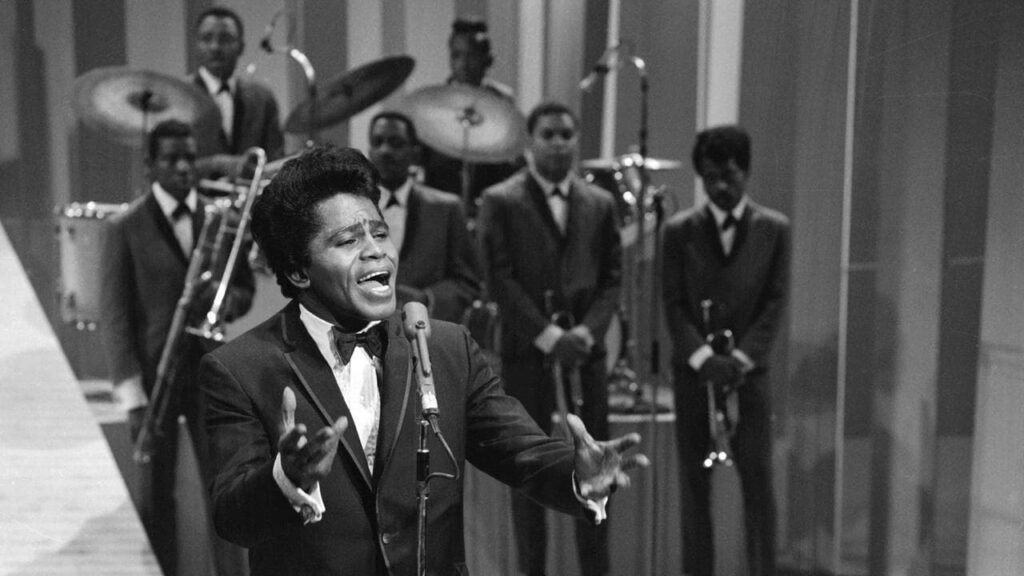
A Pulse of Freedom, Movement, and Pure Funk Spirit That Refuses to Sit Still
In 1988, the world was reintroduced to a forgotten treasure when James Brown released the compilation album Motherlode, a record that climbed to notable acclaim among funk and soul collectors and later became cherished for its rare deep cuts. Among its standout tracks is “People Get Up And Drive Your Funky Soul”, a recording originally connected to Brown’s eclectic early seventies live era. By the time it appeared on Motherlode, it felt less like a rediscovered track and more like a reminder of why James Brown remained the unshakable foundation of modern rhythm and groove.
From the first seconds, the track refuses stillness. The rhythm section enters with an elastic, syncopated swagger. The horns slice through the air like bright blades. Layered percussion builds a groove that moves the body before the mind has time to react. And then James Brown steps in, not as a singer in the traditional sense, but as a conductor of movement, a minister of motion, a man who understood that rhythm could command the room the way a heartbeat commands the body. His delivery is playful, urgent, improvisational, a fusion of spoken instruction and melodic fragments. Every shout feels like a spark. Every phrasing choice feels alive.
The title itself reads like a commandment. This is not a love ballad or a narrative track. Instead, “People Get Up And Drive Your Funky Soul” is an invitation to participate. It blurs the line between performer and audience, a call to loosen the shoulders, free the mind, surrender inhibition, and fall into the pulse. It speaks to a time when music did not simply entertain; it united strangers in a shared physical release. The song invites movement not as decoration, but as liberation.
Musically, the recording showcases what James Brown pioneered and the world later labeled as funk. The repeated bass patterns, the minimal chord structure, the strategic use of space between notes, the emphasis on the one. These ideas would ripple outward into hip hop, R&B, disco, and later pop music. Without tracks like this, the modern musical landscape would sound very different.
What sets this piece apart is how human it feels. There is no polish meant to soften edges. The groove breathes, stretches, shifts. Instruments feel alive rather than programmed. The players listen to one another and respond in real time. It captures a moment of pure musical electricity, a snapshot of James Brown and his band doing what they did best: turning rhythm into religion.
Today, “People Get Up And Drive Your Funky Soul” stands as a testament to James Brown’s power not just as a performer, but as an architect of energy. It remains a reminder that sometimes the deepest truths are felt rather than spoken and that music becomes unforgettable when it demands your body move before your mind can explain why.