
A Voice That Carries Another Man’s Words: James Taylor’s “Honey Don’t Leave L.A.” in Clearer Historical Light
When James Taylor released “Honey Don’t Leave L.A.” in 1977 on his album JT, the recording arrived during a period of renewed commercial strength and artistic stability. The album itself climbed to No. 4 on the Billboard 200, confirming Taylor’s enduring presence in a rapidly changing musical landscape. It was not a chart topping release, but its impact was substantial, reinforced by the success of “Handy Man,” which earned him a Grammy Award for Best Male Pop Vocal Performance.
One essential detail reshapes how “Honey Don’t Leave L.A.” should be understood. The song was not written by Taylor, but by Danny Kortchmar, a longtime collaborator and close associate. Kortchmar played a significant role behind the scenes in the California music scene of the 1970s, contributing not only as a guitarist but also as a songwriter whose work often carried a grounded, lived in emotional tone. Taylor’s decision to record the song reflects artistic alignment rather than autobiographical authorship.
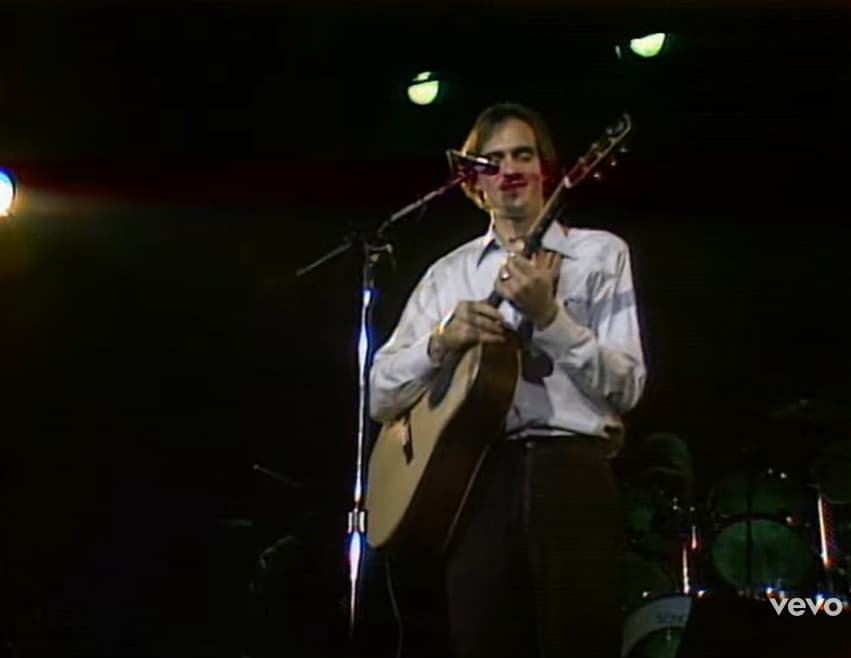
The official video presentation, understated and performance centered, aligns with the aesthetic of the era. There is little emphasis on narrative construction or visual storytelling. Instead, the focus remains on Taylor’s delivery, allowing the phrasing and tone to communicate the emotional core. This approach mirrors how many artists of his generation were documented on film, where authenticity took precedence over stylization.
Comparing the studio recording to live interpretations reveals a subtle but important distinction. The studio version is carefully arranged, with a soft rock palette that emphasizes balance and clarity. Acoustic guitar, restrained rhythm, and gentle backing vocals create a controlled environment where every element serves the composition. In live settings, Taylor often relaxes that structure. His phrasing becomes more fluid, and the vocal delivery shifts toward a conversational cadence. The song does not change dramatically in form, but its emotional temperature becomes more immediate.
Listening now with the perspective of time, the meaning of the performance evolves. Knowing that the song originates from Kortchmar introduces a layer of interpretation. Taylor is not recounting his own story in a literal sense, yet his delivery suggests deep recognition within the material. This distinction matters. It highlights his strength not only as a songwriter but as an interpreter capable of internalizing another artist’s voice without losing his own identity.
There is also a quiet sense of distance that emerges when revisiting the track today. The Los Angeles of the 1970s, the transient relationships, and the reflective tone of the singer songwriter era all feel preserved within the recording. What once might have sounded like a simple plea now resonates as a broader meditation on attachment and movement, themes that extend beyond any single author.
As the song reaches its conclusion, it resists dramatic resolution. The performance settles rather than resolves, leaving space instead of closure. That restraint remains one of its defining qualities. In the end, “Honey Don’t Leave L.A.” endures not because of grand statements, but because of its precision. It is a meeting point between writer and interpreter, captured at a moment when both voices quietly align.