
A Quiet Climb Toward Stillness Far Above the Noise
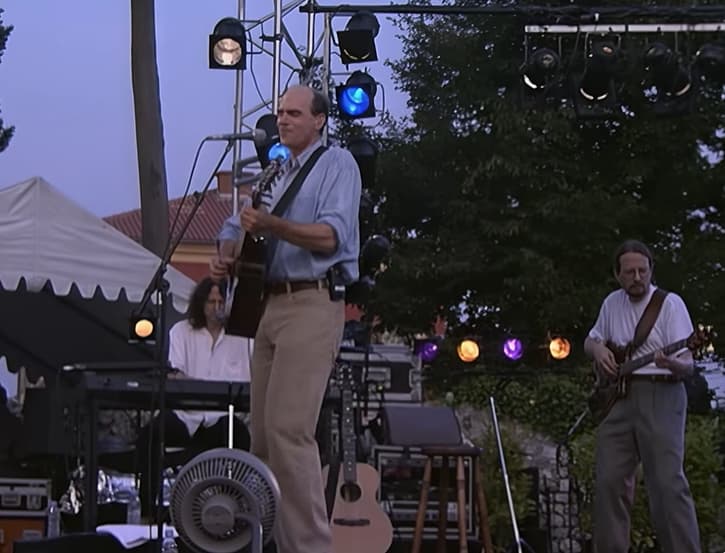
On July 16, 1999, at the storied Nice Jazz Festival in France, James Taylor performed Up On The Roof with a softness and emotional clarity that felt almost weightless. Though this version was never released as a single and did not chart, its significance lies not in commercial measurement but in the quiet authority of a master songwriter interpreting a beloved classic. It appeared during a period when Taylor was deep into his legacy as a major voice of the singer songwriter era, and this live reading shows an artist who no longer needs to prove anything. Instead, he simply inhabits the song.
Originally written by Carole King and Gerry Goffin, Up On The Roof has long been a hymn for escape, peace and mental refuge. In Taylor’s hands at Nice, it becomes something even more intimate. His acoustic guitar enters with a gentle pulse, warm and unhurried. The band behind him provides only the softest frame piano cushions the rhythm, brushes skim across the drums, and backing vocals float in at just the right moments. Nothing is rushed. Nothing is forced. Taylor sings as if the world is listening from the other side of a closed door and the only safe way to communicate is through softness.
The emotional core of the song rests in the search for a place where noise cannot follow. The lyric speaks of weariness and the need to rise above it not through defiance but through quiet withdrawal. Taylor does not treat the words as performance. He treats them as truth. When he delivers the line about escaping the world below, it feels personal and lived in. His voice carries the weight of decades spent navigating fame, grief, addiction, recovery and rediscovery. The roof becomes more than a physical location. It becomes a symbol of inner peace and emotional renewal.
Performing this song outdoors gives it a special resonance. The open night air, the Mediterranean breeze and the hum of an audience gathered under the summer sky all deepen the meaning. The song is about elevation and here it is literally lifted into the night. The music rises without ever needing to be loud.
In the context of Taylor’s long career, this performance stands out as a moment of clarity and tenderness. It shows him not as a star demanding attention but as a storyteller creating a shared moment of reflection. Up On The Roof at Nice feels like a gentle reminder that sometimes the most powerful music does not shout. It simply invites you upward to someplace softer, quieter and profoundly human.