
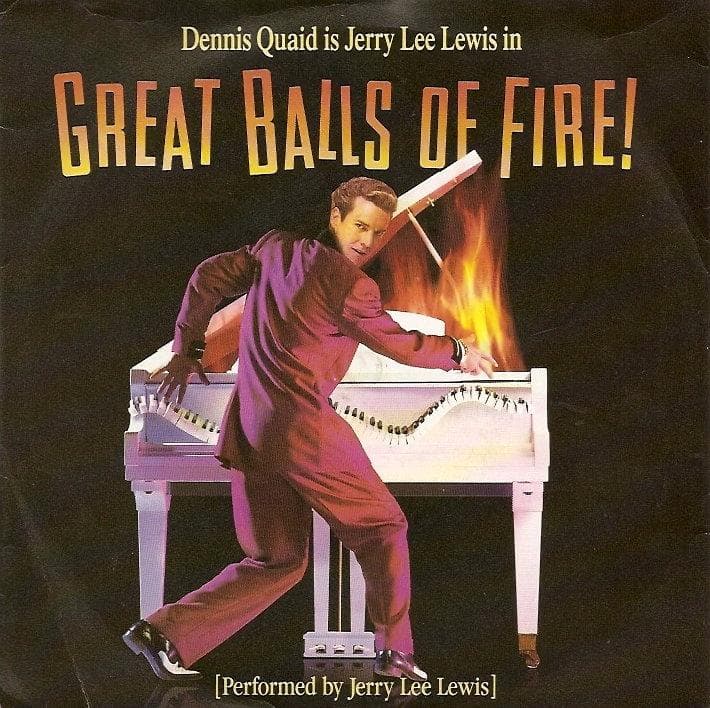
“Great Balls of Fire”: An Explosive Testament to Untamed Passion and Rock & Roll’s Fiery Birth.
For those of us who bore witness to the seismic cultural shifts of the 1950s, the emergence of rock & roll wasn’t just a musical genre; it was an untamed force, a seismic tremor that shook the foundations of polite society and redefined youth culture forever. At the very epicenter of this exhilarating explosion stood Jerry Lee Lewis, the self-proclaimed “Killer,” whose electrifying stage presence and furious piano playing embodied the genre’s raw, unbridled spirit. Among his most incandescent contributions to this revolution, “Great Balls of Fire,” released in October 1957, stands as an indisputable masterpiece – a furious, joyous, and utterly unforgettable anthem that perfectly captured the thrilling danger and irresistible allure of early rock & roll. For older readers, it’s not just a song; it’s a living, breathing memory of a time when music felt dangerous, liberating, and utterly irresistible, igniting a spark that never truly faded.
Upon its release as a single in October 1957, “Great Balls of Fire” wasn’t merely a hit; it was a phenomenon, soaring to the upper echelons of multiple charts and cementing Jerry Lee Lewis’s status as a bona fide superstar. It peaked at an astounding number 2 on the Billboard Hot 100 chart in the United States, held off the top spot only by Danny & The Juniors’ “At the Hop.” Its crossover appeal was undeniable, as it simultaneously reached number 2 on the Billboard Country & Western Best Sellers in Stores chart and sensationally topped the Billboard Rhythm & Blues Records chart at number 1. In the UK, it was equally impactful, climbing to number 1 on the UK Singles Chart, demonstrating its global reach and universal appeal. This multi-genre dominance was a testament to its raw power and the sheer force of Lewis’s performance, making it a ubiquitous presence on jukeboxes and radio waves across the world.
The story behind “Great Balls of Fire” is as legendary as the song itself, deeply intertwined with the early days of Sun Records and the visionary producer Sam Phillips. The song was written by the songwriting duo Otis Blackwell (who also penned “Don’t Be Cruel” for Elvis Presley) and Jack Hammer. However, it was Lewis’s electrifying, almost confrontational, approach to the material that transformed it from a well-crafted song into an immortal rock & roll statement. Initially, Lewis was reportedly hesitant to record the song due to its somewhat sacrilegious title and lyrics, clashing with his strong religious convictions. Famously, there was a heated argument in the studio between Lewis and Phillips, with Lewis agonizing over whether recording such a song would condemn him. Phillips, recognizing the song’s immense potential, ultimately convinced him, reportedly telling Lewis, “If you’re going to be a devil, be a devil.” This internal conflict, the very struggle between sin and salvation, only added to the song’s rebellious mystique and Lewis’s explosive delivery.
The meaning of “Great Balls of Fire” is a fervent, almost feverish, expression of overwhelming passion and desire. The phrase itself, an exclamation of astonishment or intensity, perfectly encapsulates the narrator’s burning infatuation. The lyrics speak of a love so intense it feels like a consuming blaze: “You shake my nerves and you rattle my brain / Too much love drives a man insane / You broke my will, but what a thrill / Goodness gracious, great balls of fire!” It’s a raw, uninhibited declaration of being utterly consumed by emotion, a love that’s both exhilarating and potentially dangerous, reflecting the very essence of early rock & roll – rebellious, untamed, and utterly captivating. For older readers, this song is more than just a musical memory; it’s a visceral connection to a time when emotions ran high, when dancing felt like an act of rebellion, and when music itself was a thrilling, almost dangerous, adventure. It evokes the feeling of youthful abandon, the rush of first loves, and the enduring power of a sound that still ignites a spark, reminding us that some fires, once lit, burn forever. “Great Balls of Fire” remains a quintessential piece of rock & roll history, a blazing testament to Jerry Lee Lewis’s enduring legacy as a true pioneer and the genre’s untamed heart.