
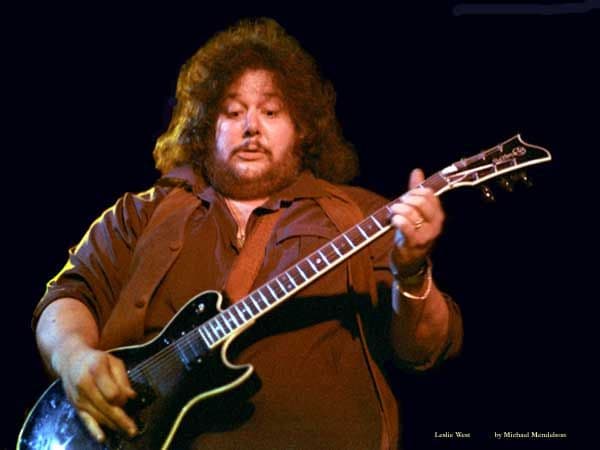
A thunderous reunion with raw instinct, where volume, grit, and soul collide in real time
When Leslie West performed “Why Dontcha” live in Paris in 1985, it was not a chart moment but a statement of survival and continuity. Captured during Mountain’s comeback tour while opening for Deep Purple, the performance revisited a song originally born from West, Bruce and Laing, the short-lived but formidable power trio of the early 1970s. Though “Why Dontcha” never stood as a mainstream hit single, its inclusion in this 1985 set carried far greater weight than chart numbers ever could. It symbolized West reclaiming a piece of his own history on a stage that demanded authority, volume, and conviction.
By 1985, Leslie West was a veteran of hard rock, a guitarist whose tone alone had already written him into history. His work with Mountain had helped define the heavy blues rock template of the early 1970s, while West, Bruce and Laing had represented an experiment in sheer power and improvisational muscle. Revisiting “Why Dontcha” during Mountain’s return was no act of nostalgia. It was a reminder that this music still breathed, still growled, still demanded attention in an era increasingly shaped by polish and technology.
Musically, the Paris performance is thick with intent. West’s guitar tone is unmistakable, wide, saturated, and unapologetically loud. Each note feels carved rather than played, bending with a human weight that modern precision often smooths away. The riff at the heart of “Why Dontcha” remains simple but brutally effective, built not for virtuosity but for impact. It moves with a slow, deliberate swagger, allowing West to lean into every phrase as if daring the audience to look away.
Vocally, West delivers the song with grit earned through years of excess, loss, and endurance. His voice in 1985 is rougher than in the early 1970s, but that roughness gives the lyrics new authority. “Why Dontcha” has always carried a confrontational edge, a challenge disguised as invitation. In this performance, it sounds less like provocation and more like lived truth. West is no longer asking a question. He is asserting presence.
The cultural context matters deeply here. Opening for Deep Purple placed Mountain in front of audiences who understood volume, endurance, and legacy. This was not a casual crowd. By choosing “Why Dontcha”, West bridged eras of heavy rock, reminding listeners that the language of power riffs and blues-based heaviness did not begin nor end with trends. It was forged earlier and carried forward by those unwilling to soften it.
This performance also reveals West’s artistic integrity. Rather than relying solely on Mountain classics, he reached back to West, Bruce and Laing, acknowledging a chapter of his career that was often overshadowed. In doing so, he presented himself not as a revival act, but as a continuous force, evolving yet grounded.
Listening today, “Why Dontcha” live in Paris in 1985 feels like a document of defiance. It captures a musician standing firm in his sound, his tone, and his identity. There is no compromise here, only amplification of intent. It reminds us that true heavy rock does not age politely. It endures, scars intact, still loud enough to shake the room.