
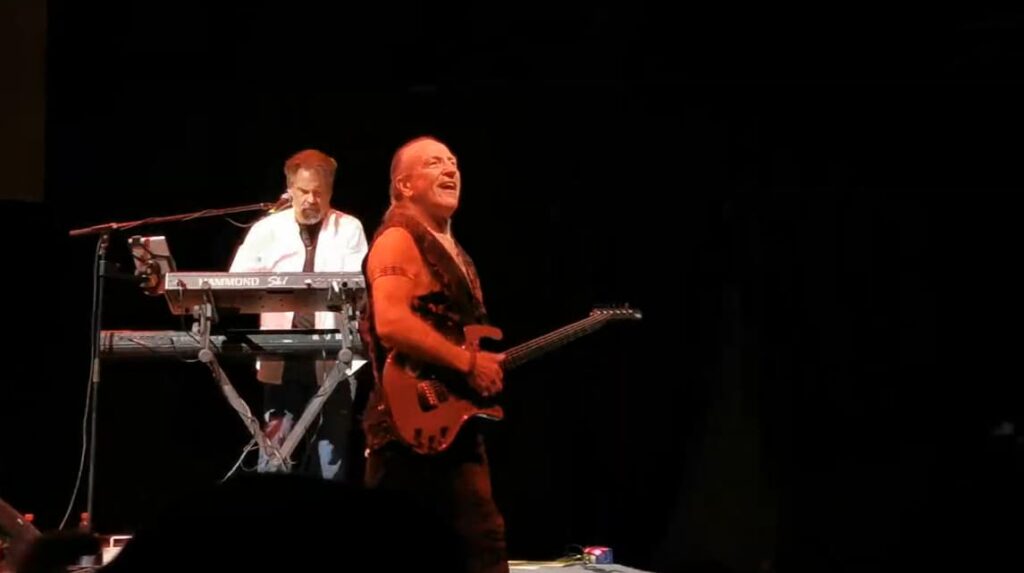
A Thunderous Revival of Blue Collar Rock Energy That Refuses to Age
When Mark Farner took the stage in Santiago, Chile in 2019 to perform “Footstompin’ Music”, he was revisiting one of the defining anthems of his career, originally made famous with Grand Funk Railroad on the 1971 album Survival, which reached number 9 on the US Billboard 200. The song itself had long been a staple of classic rock radio and live shows, and this later performance confirmed something essential: its pulse, its defiance, and its communal power remained undiminished decades after its release.
In its original form, “Footstompin’ Music” was never subtle. It was built as a declaration, a celebration of volume, sweat, and the shared physical experience of rock and roll. Farner wrote it as a response to critics who dismissed Grand Funk as crude or unsophisticated. Rather than refine their sound to satisfy tastemakers, the band doubled down on what connected them to millions of listeners. The song’s driving rhythm, blues-based structure, and unrelenting momentum became a manifesto for working-class rock fans who wanted music that moved their bodies as much as their spirits.
The Santiago performance in 2019 brings that original intent into sharp relief. Farner, older but visibly energized, approaches the song not as a nostalgic relic but as a living force. His guitar tone remains thick and muscular, anchored in the same raw blues vocabulary that fueled the early 1970s recordings. His voice, while weathered by time, carries an added gravity. There is conviction in every phrase, a sense that the song’s message has only grown more meaningful with age. This is not about reliving youth. It is about reaffirming identity.
What stands out most in this live rendition is the interaction between Farner and the audience. “Footstompin’ Music” was always designed as a call to action, and in Santiago, the crowd answers enthusiastically. The stomping rhythm becomes communal, almost ritualistic. The song’s repetition, once criticized as simplistic, reveals its deeper function. It is a unifying chant, a reminder that rock music thrives on participation, not passive consumption.
Culturally, the performance underscores Farner’s enduring connection to international audiences. Grand Funk Railroad was once labeled an American phenomenon, yet here in Chile, decades later, the song resonates just as powerfully. That global response speaks to the universality of its message. Loud music, played with conviction, can still bridge generations and borders.
Seen through the lens of time, “Footstompin’ Music” in 2019 becomes more than a revival. It stands as evidence of artistic consistency. Farner never disowned the rawness of his early work. Instead, he carried it forward, allowing it to age alongside him. The Santiago performance captures that continuity beautifully. It is a reminder that rock and roll, when rooted in honesty and physical expression, does not grow obsolete. It simply grows louder in memory and meaning.