
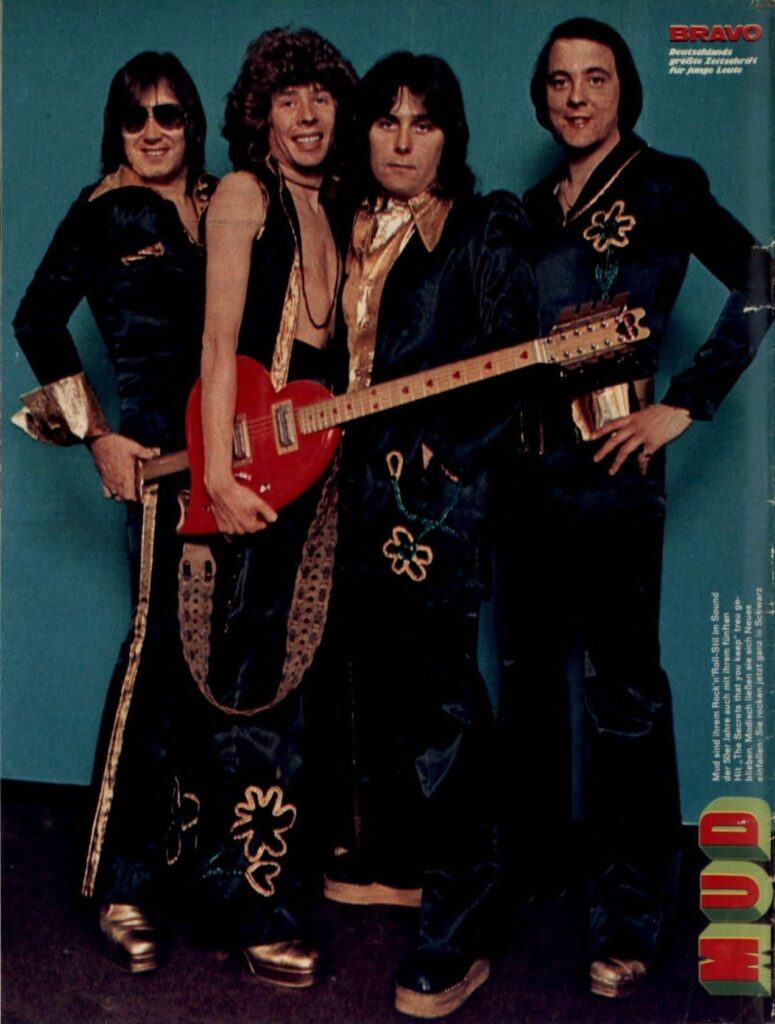
A playful burst of glam-era charm that turns a classic pop tune into a swaggering moment of pure Mud mischief
When Mud included “Living Doll” on their 1975 release Mud Rock Vol. II, the track carried no chart placement of its own, yet it instantly became one of those irresistible album cuts that reflected the band’s love for lighthearted theatrics and vintage pop reinvention. Taking on the well-known Cliff Richard hit from 1959, Mud reshaped the song with their unmistakable glam-rock personality, spinning it into a cheeky celebration of nostalgia at a time when the band was already riding high on the success of their mid-70s streak. This was Mud doing what they did best: reviving the musical past with a grin, a stomp, and a shimmer of glitter.
Their version of “Living Doll” works because it does not attempt to compete with the original. Instead, it functions as an affectionate wink toward an earlier era of British pop, an era that shaped the band long before they stepped onto the Top of the Pops stage. Mud approached the song like a band paying tribute to the music that first sparked their adolescent dreams, but they infused it with enough swagger, rhythmic punch, and vocal playfulness to make it unmistakably theirs. The result is not an imitation but a reinterpretation, one that lets the group revel in their love for doo-wop, rock and roll, and the innocent flirtation of late-50s melodies.
What makes their rendition particularly engaging is the band’s warm sense of humor, a hallmark of Mud’s identity. They never treated oldies with reverence; they treated them like living, breathing things that could be dressed up, teased, and adorned with glam-era attitude. In “Living Doll,” that attitude comes through in the slightly exaggerated phrasing, the rhythmic bounce, and the subtle edge of theatrical exaggeration. It is as if the band is inviting the listener to join in on a private joke, a reminder that rock and roll began as something fun before it became something mythologized.
Musically, the track is anchored by tight harmonies and a groove that leans closer to Mud’s own style than to the original song’s relaxed charm. The guitars are brighter, the rhythm section more assertive, and the vocals carry a sly grin that makes the performance feel both affectionate and irreverent. There is a looseness to the recording, a sense of camaraderie that suggests the band enjoyed themselves during the session. You can almost hear the smiles in the delivery.
Over time, “Living Doll” has become one of those album moments that fans return to as a reminder of Mud’s ability to bridge eras with effortless joy. It is not a grand artistic statement or a dramatic reinvention, but rather a small, shining symbol of what made the band special. Mud understood that rock and roll is as much about spirit as it is about sound, and in this lively, respectful, and delightfully cheeky cover, that spirit is alive and well.