
The Haunting Echo of a Broken Heart, a Timeless Lament on the Profound Pain of Love Lost.
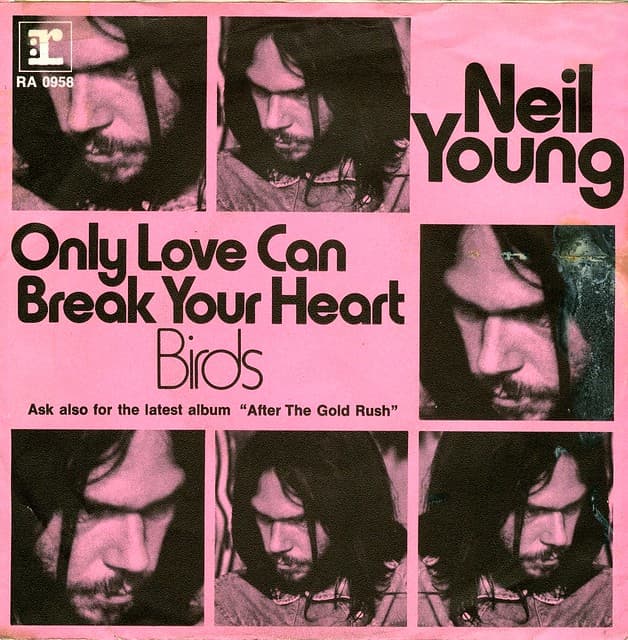
In the hallowed halls of folk-rock, few albums carry the weight and emotional resonance of Neil Young’s 1970 masterpiece, After the Gold Rush. It is a record that feels less like a collection of songs and more like a series of vivid, sepia-toned snapshots from a past that is both deeply personal and universally understood. Tucked between the album’s sprawling, apocalyptic title track and the gentle beauty of “Southern Man” is a song that stands as a quiet monument to a universal truth: “Only Love Can Break Your Heart.” Released as a single in October 1970, this song marked a significant milestone in Young’s career, becoming his first Top 40 solo hit, climbing to a respectable number 33 on the US charts. Its success, however, was less about commercial triumph and more about the simple, undeniable power of its message, delivered with a fragile honesty that could only belong to him.
The story behind this seemingly simple song is shrouded in the kind of folklore that often surrounds iconic music. While the most widely accepted theory holds that Young wrote it for his friend and Crosby, Stills, Nash & Young bandmate, Graham Nash, following Nash’s devastating split from singer-songwriter Joni Mitchell, there are other whispers of inspiration. Young himself has been known to be cagey about the song’s origins, either due to a genuine lack of memory or a desire to maintain its enigmatic aura. This tentativeness only adds to the song’s mystique. Interestingly, filmmaker Bob Giuliana has offered a different, equally compelling narrative, claiming that Neil wrote the song about his personal heartbreak after leaving a film company. This alternative story suggests the song’s meaning is broader than a romantic breakup, extending to the unique and profound pain of losing a cherished career or a sense of purpose. This ambiguity, in a way, is the very essence of the song’s enduring appeal; it’s a testament to the fact that the most powerful art can contain multiple truths, speaking to different forms of loss with equal sincerity.
The song’s meaning is laid bare in its simple, almost brutally direct title. It’s a somber acknowledgment that while many things in life can cause pain, it is the unique vulnerability that comes with deep affection that truly has the power to shatter us. The lyrics, sparse and unadorned, are a quiet lament, a gentle hand on the shoulder of someone enduring that specific kind of ache. Lines like “When you were young and on your own / How did it feel to be alone? / I was always there to pick you up / But I never thought I’d see the day / When you’d be the one to go away” are a testament to the song’s masterful economy of language. It’s a seemingly simple song that, upon closer inspection, reveals a subtle and meticulous attention to detail in its instrumentation. The gentle strumming of the acoustic guitar, the haunting, almost ethereal harmonies, and the subdued rhythm create an atmosphere of profound melancholy and quiet contemplation.
For those who lived through that golden age of singer-songwriters, “Only Love Can Break Your Heart” is more than a song; it’s a shared memory, a piece of a collective emotional landscape. It speaks to a time of innocence and disillusionment, a time when music felt like a trusted confidant, a voice that understood the complexities of the heart. The song’s beauty lies in its quiet power, its ability to cut through the noise and deliver a raw, unvarnished truth. It is a timeless reminder that while love can bring the highest highs, it also opens us up to the most profound of sorrows, and that in the end, it is this bittersweet vulnerability that makes us truly human.