
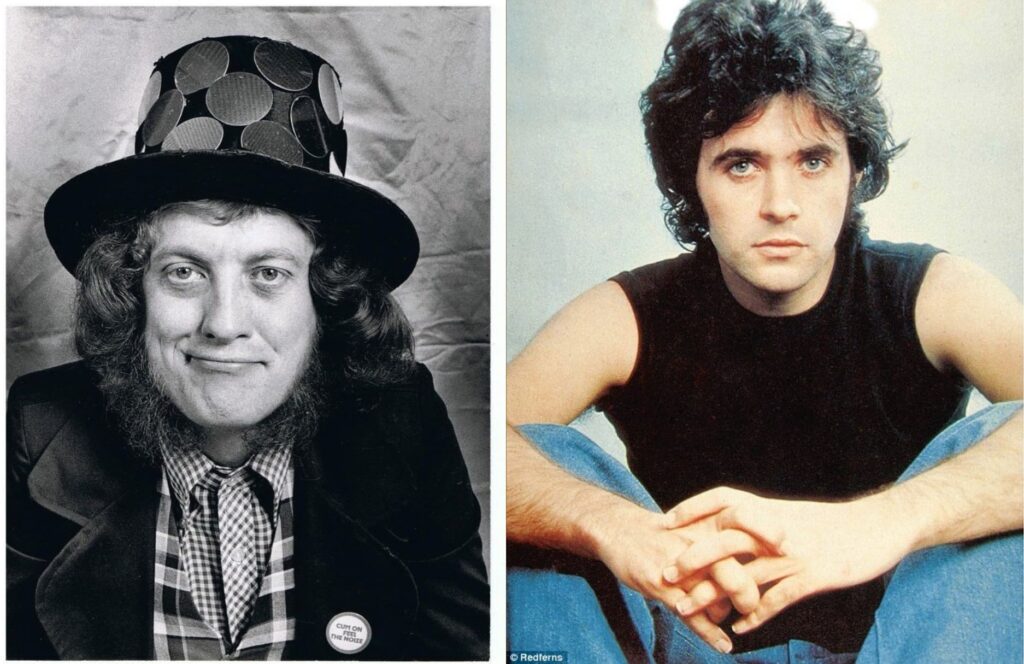
A reflective reunion where two voices of the seventies look back with warmth, wit, and hard-earned perspective
When Noddy Holder of Slade and David Essex appeared together on TV-am’s Good Morning Britain on 17 August 1990, the segment offered more than a routine television interview. Broadcast nearly two decades after their shared era of dominance, the conversation unfolded as a measured reflection on the cultural force of the 1970s, framed by presenters Lorraine Kelly and Richard Keys. While the appearance itself was not tied to charts or a specific release, its significance lies in how it captured two defining figures of British popular music pausing to take stock of a decade that reshaped both their lives and the wider musical landscape.
By 1990, both men carried the weight of lived history. Noddy Holder, whose unmistakable voice powered Slade’s run of chart-topping singles and era-defining anthems, represented the raw, communal energy of glam rock and working-class celebration. David Essex, by contrast, embodied a more introspective and theatrical strain of the decade, blending pop stardom with acting and a carefully cultivated emotional openness. On Good Morning Britain, these contrasting paths met not in competition, but in mutual recognition.
What makes the discussion compelling is its tone. There is no attempt to mythologize the 1970s as a lost golden age, nor any impulse to distance themselves from it. Instead, both artists speak with an easy honesty about fame, pressure, and the strange velocity of success. Holder’s reflections carry the grounded pragmatism that always defined his public persona. He speaks as someone who understood early that pop stardom was fleeting, and that the real achievement lay in connecting with audiences night after night. Essex, more reflective, addresses the emotional demands of visibility and the challenge of maintaining authenticity while navigating mass adoration.
The exchange subtly reveals how the 1970s functioned as both opportunity and crucible. This was a decade when British music exploded outward, becoming louder, bolder, and more accessible. Yet it was also a time of relentless exposure, where artists were consumed as quickly as they were celebrated. Watching Holder and Essex speak from the vantage point of 1990, there is a shared sense that survival required adaptability and self-awareness. Neither man speaks with bitterness. Instead, there is gratitude tempered by realism.
The presence of Lorraine Kelly and Richard Keys grounds the discussion firmly in its moment. Their questions frame the conversation for a new generation of viewers, many of whom would have known these artists more as cultural references than current chart forces. This generational shift adds an unspoken layer to the segment. The interview becomes not just a reminiscence, but a bridge between eras, translating the intensity of the 1970s into language that still resonates.
In retrospect, this appearance stands as a quiet cultural document. It captures two artists no longer chasing relevance, but offering perspective. The laughter is genuine, the memories unguarded, and the insights earned. For those who lived through the 1970s, it is a moment of recognition. For those who came later, it is a reminder that behind the hits, the headlines, and the hairstyles were individuals navigating change in real time. Seen today, the segment endures as a thoughtful pause in the ongoing story of British popular music, where reflection becomes its own form of legacy.