
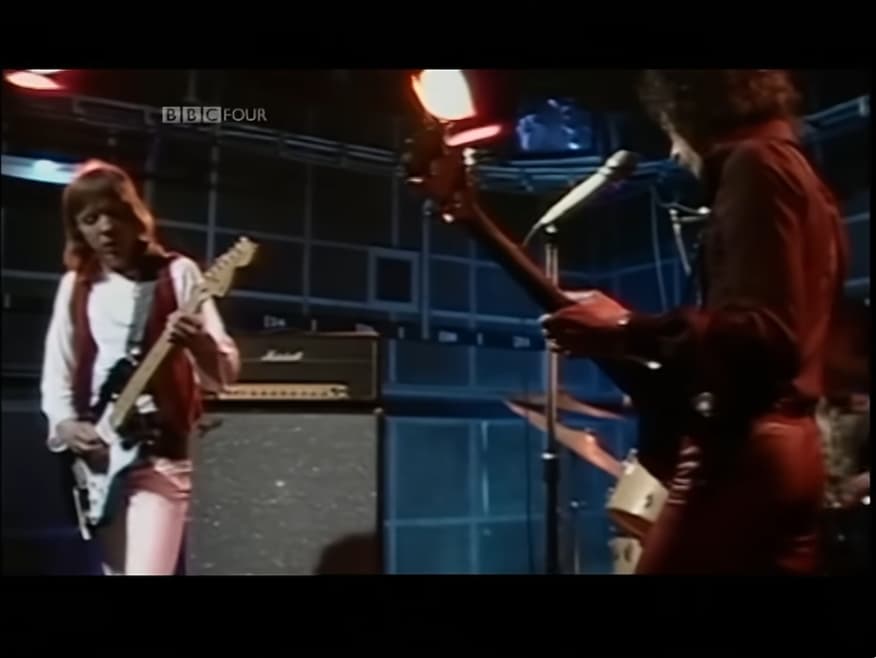
A Guitar Speaks in Shadows: Robin Trower’s “Bridge of Sighs” on British Television in 1974
In 1974, Robin Trower appeared on British television to perform “Bridge of Sighs,” offering viewers a striking example of how restraint and tone could redefine the language of rock guitar. At a time when many performances leaned toward spectacle, this appearance stood apart for its focus on atmosphere and control.
“Bridge of Sighs” was the title track of Trower’s second solo album, released in 1974 following his departure from Procol Harum. The record marked a turning point in his career, establishing him as a leading figure in blues rock. The song itself became closely associated with his style, built around a slow tempo, sustained guitar lines, and a distinctive use of effects that created a spacious and immersive sound.
In this televised performance, those qualities are immediately apparent. The arrangement unfolds gradually, with the guitar taking a central role not as a vehicle for speed, but as a means of shaping mood. Trower’s phrasing is deliberate, allowing notes to linger and develop rather than rushing toward resolution. This approach gives the performance a sense of depth that contrasts sharply with the more direct energy of mainstream rock at the time.
Supporting him is a tightly controlled rhythm section that maintains a steady foundation without drawing attention away from the lead instrument. The balance between guitar and rhythm is essential, creating a framework in which each element serves the overall atmosphere. The result is a performance that feels cohesive and focused, even within the limitations of a television studio setting.
The significance of this appearance also lies in its timing. By 1974, the rock landscape was expanding rapidly, with artists exploring new textures and influences. Trower’s work, often compared to that of Jimi Hendrix, reflected this evolution while maintaining its own identity. Rather than emphasizing technical display alone, he prioritized tone, space, and emotional nuance.
What makes this clip particularly valuable today is its clarity. There are no elaborate stage effects or visual distractions. The emphasis remains on sound and performance, allowing viewers to engage directly with the music. In this environment, Trower’s approach becomes even more evident, highlighting the precision behind what might initially seem effortless.
Viewed from a contemporary perspective, this performance serves as a reminder of a period when innovation in rock music often emerged through subtlety rather than excess. Robin Trower does not attempt to overwhelm the listener. Instead, he invites attention, building a sound that rewards patience and careful listening.
In doing so, “Bridge of Sighs” becomes more than a song. It becomes an experience shaped by tone, timing, and the quiet confidence of an artist fully in command of his craft.