
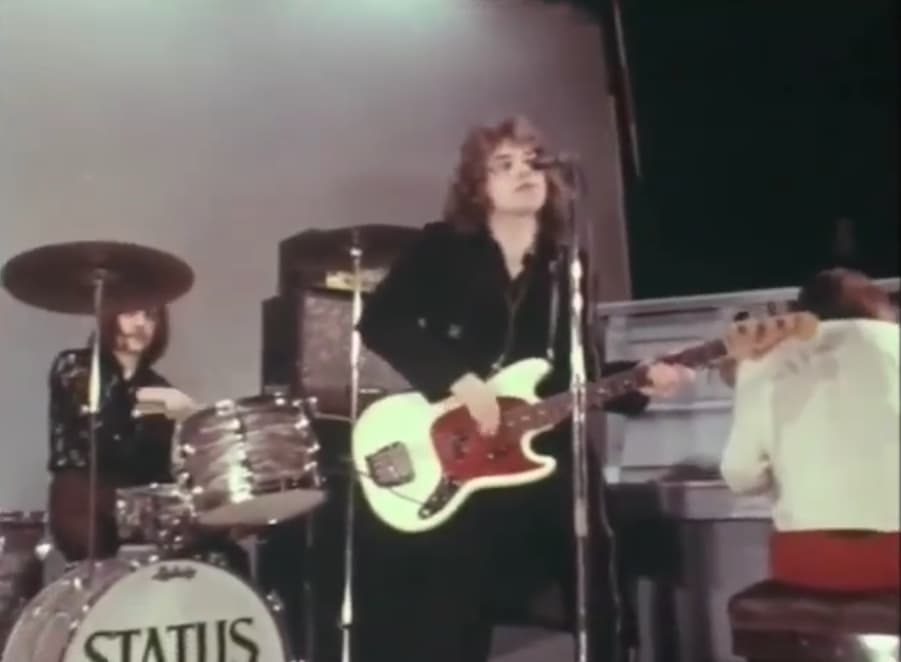
Down The Dustpipe and the Turning Point in Status Quo’s Early Career
Down The Dustpipe occupies a pivotal place in the early development of Status Quo. Released on August 1, 1970, and later included on the album Ma Kelly’s Greasy Spoon, the single marked a decisive shift away from the psychedelic pop sound that had first brought the band chart success in the late nineteen sixties. Issued under Sanctuary Records, a catalog now administered by BMG, the track remains one of the clearest indicators of the group’s changing musical direction at the dawn of a new decade.
Produced by John Schroeder and composed by Carl Groszmann, Down The Dustpipe introduced a heavier, more driving guitar approach that would soon become the band’s defining characteristic. While earlier hits had leaned toward melodic pop structures, this recording emphasized rhythm, repetition, and a rawer tonal edge. The guitars are prominent and assertive, supported by a steady rhythm section that prioritizes groove over ornamentation. The result is a sound that feels more grounded and direct.
Commercially, the single performed strongly in the United Kingdom, reaching the top fifteen of the national charts. This success confirmed that audiences were receptive to the band’s stylistic evolution. Rather than alienating listeners, the heavier approach helped solidify Status Quo’s emerging identity as a no nonsense rock act.
The association with Ma Kelly’s Greasy Spoon further underscores the importance of the song. That album represented the first clear statement of the band’s move toward a harder rock framework. Down The Dustpipe fits naturally within that context, acting as both a bridge from the past and a foundation for what would follow. In retrospect, it is often cited as the moment when Status Quo began shaping the formula that would define much of their output throughout the nineteen seventies.
The track’s availability through official channels, including its distribution on digital platforms by Sanctuary Records, has allowed newer generations to access this formative period. While later anthems would bring even greater commercial recognition, Down The Dustpipe retains historical weight because it captures the band in transition.
More than five decades after its release, the recording stands as an important document of artistic recalibration. It demonstrates how Status Quo responded to changing musical climates not by chasing trends, but by refining their own strengths. Down The Dustpipe remains a concise and confident statement from a band on the verge of defining its long term identity in British rock.