
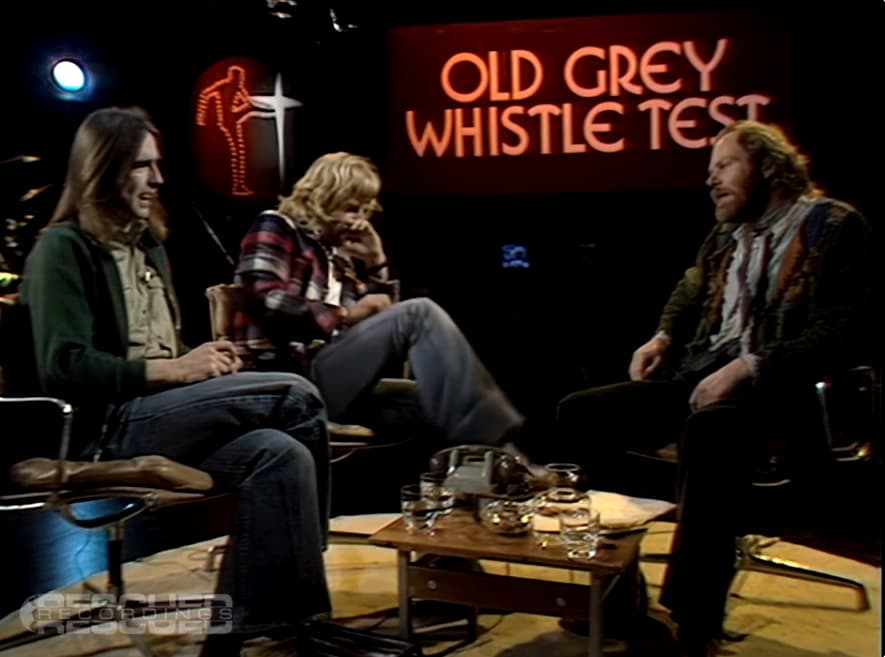
Status Quo on The Old Grey Whistle Test 1977 A Milestone Marked with Reflection and Recognition
On the third of May nineteen seventy seven, Status Quo appeared on BBC Two’s The Old Grey Whistle Test for a broadcast that served both as a celebration and a moment of reflection. The programme marked the band’s fifteenth anniversary, acknowledging a journey that had taken them from early beat and psychedelic roots to their position as one of Britain’s most dependable rock acts.
Hosted by Bob Harris, the episode opened with a warm acknowledgment of the band’s devoted following. Harris noted that hardly a week passed without viewers writing in to demand a Status Quo appearance. In response, Francis Rossi and Rick Parfitt were welcomed into the studio, not only as guests but as veterans of a rapidly changing music industry.
A central feature of the broadcast was the presentation of Old Grey Whistle Test badges to the band, a small but meaningful symbol of credibility within British music television. These badges carried particular weight because the programme was known for its discerning audience and its focus on musicianship rather than chart position alone.
The episode also looked back to the band’s beginnings. Archival footage from a nineteen sixty eight edition of Top of the Pops was shown, featuring Pictures of Matchstick Men, the song that first brought Status Quo national attention. The contrast between the youthful, experimental group in the clip and the confident, seasoned musicians in the studio underlined the distance the band had travelled in fifteen years.
During the interview, Rossi and Parfitt spoke candidly about their early struggles, recalling working men’s clubs, unreliable gigs, and periods when the wider music business seemed to stall. They discussed how persistence rather than planning had carried them through difficult years, particularly around the late nineteen sixties, when many bands dissolved under pressure. Their reflections were grounded and unsentimental, emphasizing rehearsal, touring, and the simple determination to continue.
The conversation also touched on the changing state of the music industry. Rossi suggested that bands become more detached as they grow larger, less connected to the grassroots club circuit where new movements are born. Despite this distance, both musicians expressed a practical outlook toward the future, describing plans for new recordings and continued touring rather than long term predictions.
This appearance on The Old Grey Whistle Test was not defined by spectacle or performance alone. Instead, it functioned as a quiet acknowledgment of endurance. By combining archival footage, honest discussion, and formal recognition, the programme captured Status Quo at a moment when experience had replaced uncertainty, and survival itself had become an achievement.