
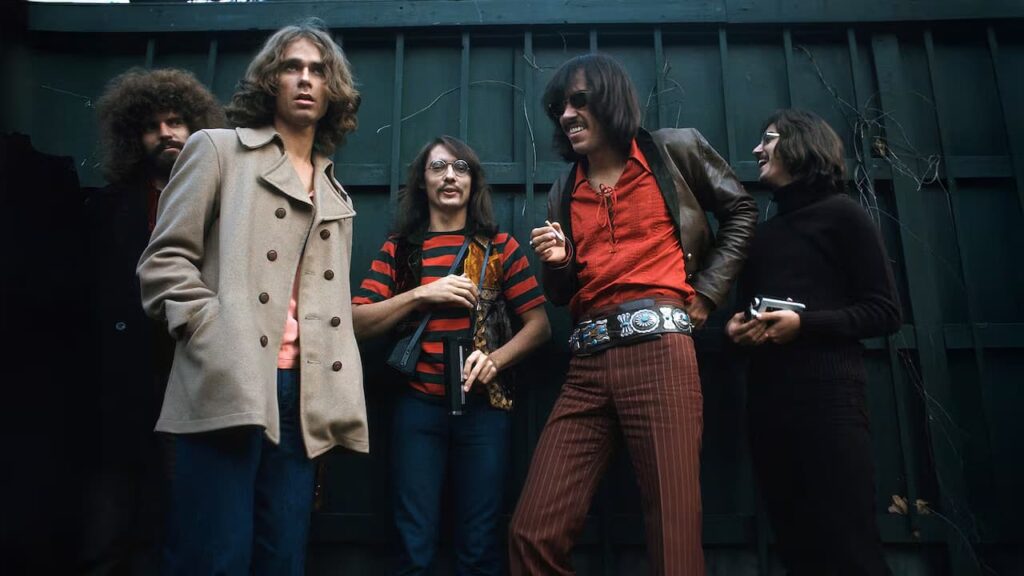
When a Riff Became a Revolution: Steppenwolf Reignite “Born To Be Wild” on National Television
On February 21, 1975, Steppenwolf stepped onto the stage of The Midnight Special and delivered a performance that felt less like a routine television appearance and more like a cultural recall. Their song “Born To Be Wild” had already secured its place in rock history, yet this broadcast revealed something deeper about its enduring power and the shifting landscape of mid 1970s music.
By 1975, rock had evolved into more elaborate and theatrical forms. Progressive compositions were stretching the limits of structure, while glam aesthetics dominated visual presentation. Against this backdrop, Steppenwolf appeared almost defiantly stripped down. There was no excess, no spectacle competing for attention. Instead, the band leaned into the raw architecture of the song itself, allowing its instantly recognizable guitar riff to command the room within seconds. It was a reminder that some of rock’s most powerful statements are built on simplicity and conviction rather than complexity.
Frontman John Kay delivered the vocal with a gritty authority that resisted polish. His voice carried the spirit of the open road, reinforcing the song’s long standing association with freedom and movement. That connection had been cemented years earlier through its inclusion in Easy Rider, a film that transformed the track into an anthem for a generation searching for identity beyond convention. By the time of this television performance, the song no longer belonged solely to the band. It had become part of a broader cultural memory.
One of the most compelling dimensions of the performance lies in its historical irony. The phrase “heavy metal,” first popularized within the song’s lyrics, had by 1975 already begun to define an emerging genre. Yet Steppenwolf themselves stood slightly apart from that evolution. Watching them perform on national television offered a rare moment in which the origin of an idea and its later transformation coexisted in real time.
The closing moments of the performance did not rely on dramatic gestures. Instead, they left a lingering impression that the song extended beyond the stage, echoing the endless motion it celebrates. This quality has always distinguished “Born To Be Wild” from its contemporaries. It does not conclude so much as it continues in the listener’s imagination.
Decades later, this broadcast remains a valuable document of transition. It captures a band revisiting its defining work while the culture around it moves forward. More importantly, it affirms that certain songs do not age in the conventional sense. They adapt, resonate, and persist, carrying their original spirit into new contexts without losing their identity.