
“Black And White”: A Joyful Anthem for Racial Harmony and Childhood Innocence.
For those of us who navigated the tumultuous yet hopeful currents of the early 1970s, a period marked by both social unrest and a burgeoning call for unity, certain songs served as a vibrant, optimistic beacon. Three Dog Night, with their powerful vocal harmonies and eclectic blend of rock, pop, and soul, consistently delivered tracks that captured the zeitgeist. Among their most endearing and impactful, “Black And White” stands as a jubilant testament to racial harmony and the inherent innocence of childhood, a vision of a world where differences fade in the glow of shared joy. Released in the summer of 1972, this song wasn’t just a hit; it was a cultural embrace, a simple yet profound message delivered with an irresistible rhythm that resonated deeply, particularly with those who longed for a more equitable and understanding society.
Upon its release as a single in July 1972, “Black And White” immediately soared up the charts, becoming another significant success in Three Dog Night’s impressive string of hits. It reached the coveted number 1 position on the Billboard Hot 100 chart in September 1972, holding that spot for a full week. It also performed strongly on the Adult Contemporary chart, peaking at number 4. This overwhelming popularity underscored the song’s universal appeal and its timely message, finding a receptive audience eager for its optimistic outlook. Featured on their album Seven Separate Fools, which was released in July 1972 and reached number 6 on the Billboard 200, “Black And White” quickly became one of the band’s most memorable and beloved tracks. For many of us, hearing its distinctive guitar riff and those soaring harmonies on the radio was an instant invitation to feel good, to feel hopeful, and to remember a simpler truth.
The fascinating story behind “Black And White” is that it wasn’t an original composition by Three Dog Night. The song was actually written by two talented individuals, David I. Arkin (father of actor Alan Arkin) and Earl Robinson, way back in 1956. It was originally composed to celebrate the landmark 1954 Supreme Court decision, Brown v. Board of Education, which declared state-sponsored segregation in public schools unconstitutional. This early version was recorded by Pete Seeger, and later by various folk artists, carrying its poignant message through the burgeoning Civil Rights Movement.
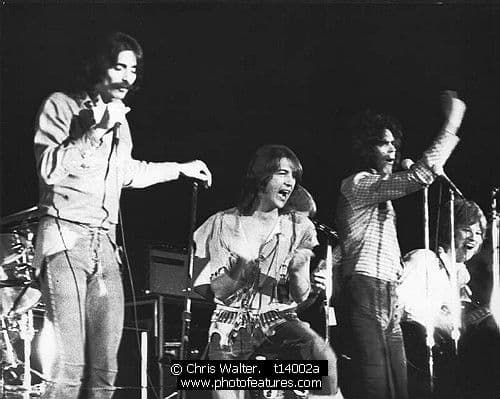
Three Dog Night’s decision to cover this particular song in the early ’70s was incredibly astute. At a time when racial tensions still simmered and the wounds of segregation were far from healed, their powerful, pop-infused rendition brought this vital message to a much broader, mainstream audience. The band’s three vocalists, Danny Hutton, Chuck Negron, and Cory Wells, brought their signature blend of soulful urgency and pop sensibility to the track, transforming it from a folk protest song into a vibrant, universally accessible anthem. The arrangement, with its distinctive reggae-influenced guitar intro and infectious rhythm, made the serious message digestible and even joyful, proving that profound social commentary could also be incredibly catchy.
The meaning of “Black And White” is beautifully explicit in its lyrics, yet deeply moving in its simplicity. It paints a picture of children of all races playing together, oblivious to the artificial divisions that adults often create: “The ink is black, the page is white / Together we learn to read and write / A child is black, a child is white / The whole world looks upon a sight / A beautiful sight, a beautiful sight / As black and white together unite.” It emphasizes that true understanding and unity begin in childhood, before prejudice takes root. The song’s central message is that harmony is not only possible but natural when seen through the innocent eyes of a child, who sees only a playmate, not a color. For older readers, this song evokes a powerful wave of nostalgia not just for their own youth, but for the optimism of an era that dared to dream of a more inclusive world. It serves as a heartwarming reminder of the progress made, but also perhaps a gentle nudge that the journey towards true equality and understanding is an ongoing one, forever rooted in the simple truth that, fundamentally, we are all just “black and white together unite.”