
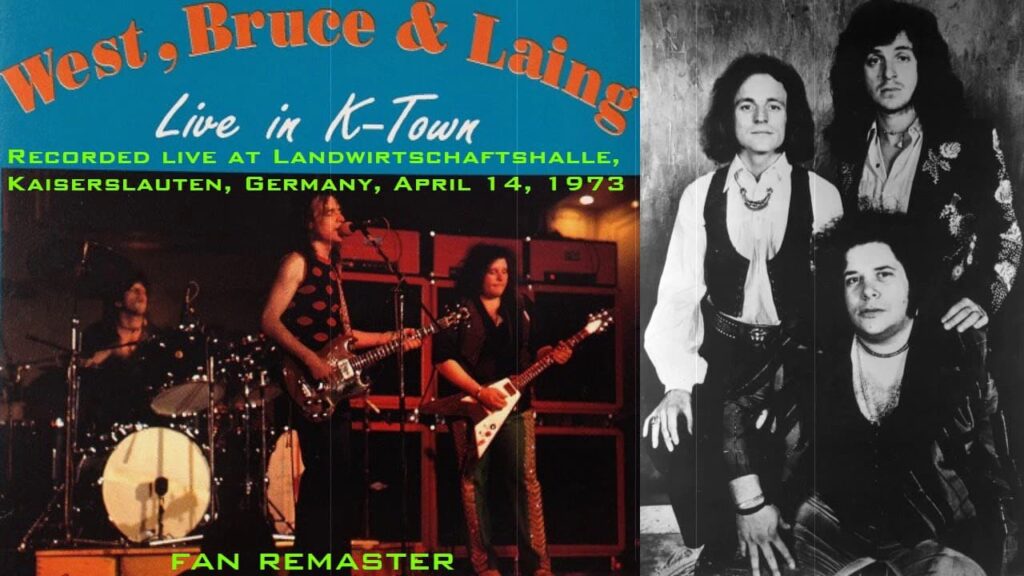
Playing With Fire While the Band Burns: West, Bruce & Laing at Full Friction
By the time “Play with Fire” was captured for Live ’n’ Kickin’, West, Bruce & Laing were already a band in name more than in future. The album would arrive in 1974, but the group itself had effectively unraveled before it reached the public. That context is not background trivia. It is the key to understanding why this performance feels less like a concert and more like a document of controlled collapse.
Originally written by The Rolling Stones, “Play with Fire” is not treated here as a reverent cover. It is dismantled and rebuilt into something heavier, slower, and far more confrontational. The familiar structure becomes a loose framework for something closer to a prolonged confrontation between three musicians who have no interest in staying within polite boundaries.
From the outset, Leslie West sets the tone with a dense, grinding guitar sound that refuses subtlety. His approach is direct, almost confrontational, as if the goal is to dominate the space rather than share it. Across from him, Jack Bruce does what he has always done when placed in a traditional role. He rejects it. His bass lines move independently, pushing against the guitar instead of supporting it, creating a constant sense of tension that never fully resolves.
Between them, Corky Laing acts less like a timekeeper and more like a stabilizing force. His drumming does not smooth out the friction. It contains it, preventing the performance from collapsing entirely under the weight of competing ideas. Without that anchor, the piece might drift into complete disarray.
What makes this version remarkable is its scale. Stretching well beyond the confines of the original song, it evolves into an extended exchange that feels closer to an argument than a composition. There are no clear boundaries between sections, no obvious cues that guide the listener toward resolution. Instead, the performance sustains a level of intensity that suggests none of the players are willing to concede space.
The irony of the title becomes unavoidable. “Play with Fire” is a warning, but here it reads more like a statement of intent. This is a band actively engaging with instability, pushing itself into a space where control is constantly at risk. Given the group’s imminent dissolution, the metaphor lands with unusual precision.
When the performance finally ends, it does not resolve in any conventional sense. It simply stops, as if the energy sustaining it has reached its limit. There is no clean conclusion, no sense of closure.
In hindsight, that unfinished quality feels entirely appropriate. West, Bruce & Laing were never about balance or longevity. They were about impact. And in “Play with Fire,” that impact is preserved at the exact moment it begins to consume itself.