
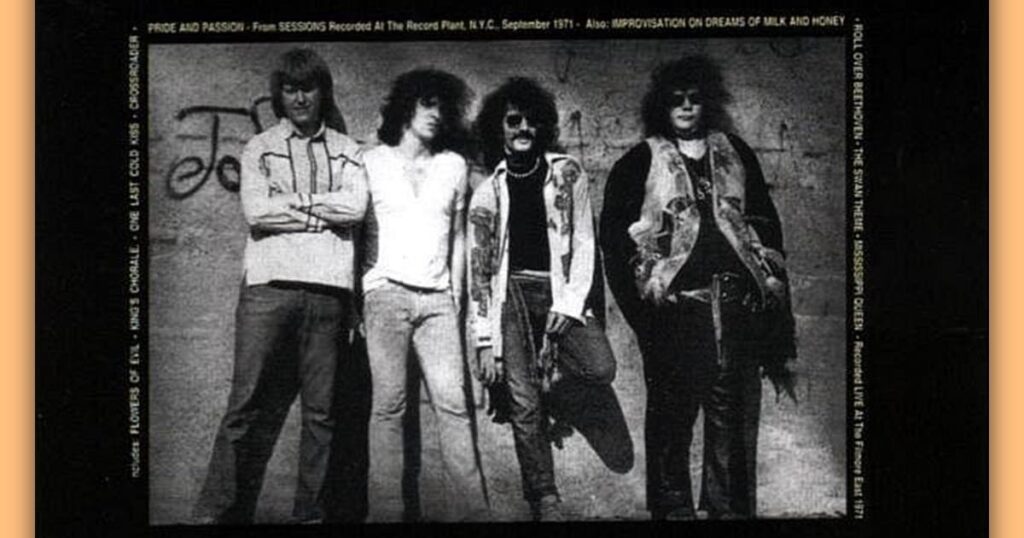
When Mountain Took Heavy Rock to the Edge of the Stage: The Power of “Mississippi Queen” and the Live Fire of Flowers of Evil
In the early nineteen seventies, few American rock bands carried the same raw authority as Mountain. Built around the towering guitar tone of Leslie West and the musical vision of bassist and producer Felix Pappalardi, the group became one of the defining forces of early American heavy rock. Their 1971 album Flowers of Evil stands as a compelling document of that power, combining carefully crafted studio songs with an extended live performance that captured the band at full intensity.
Released in November 1971 by Windfall Records and distributed by Columbia Records, Flowers of Evil arrived during a period when Mountain were rapidly building a reputation as one of the loudest and most commanding live bands in the United States. The record’s first side presented studio material such as the title track “Flowers of Evil,” the blues influenced “Crossroader,” and the haunting “One Last Cold Kiss.” These songs revealed the band’s range, moving from heavy riff driven rock to moments of reflective melody.
Yet the most striking portion of the album came on its second half. Two tracks were recorded live, capturing Mountain on stage with a massive sound that reflected their reputation on the touring circuit. The centrepiece of this live material was “Dream Sequence,” an expansive twenty five minute improvisational performance. Rather than a conventional song, the piece unfolded as a series of connected musical ideas that allowed the band to stretch far beyond the structure of their studio recordings.
During this extended performance, guitarist Leslie West delivered one of the most commanding displays of tone and phrasing heard in early seventies rock. His solo passages moved fluidly between blues rooted expression and explosive heavy rock. The performance also included a playful moment with a brief interpretation of Roll Over Beethoven, the classic composition by Chuck Berry that had long been part of rock and roll tradition.
Alongside West, Felix Pappalardi anchored the music with a melodic bass style that revealed his deep musical background. Before forming Mountain, Pappalardi had already established himself as an influential producer, most notably through his work with Cream. His experience helped shape Mountain’s sound into something both heavy and musically sophisticated.
The live section of the album concluded with a concise but explosive rendition of “Mississippi Queen.” Originally released on the band’s debut album Climbing! in 1970, the song had quickly become Mountain’s signature anthem. Its unforgettable opening cowbell, thunderous riff, and commanding vocal from Leslie West made it one of the defining tracks of early American hard rock.
On the Flowers of Evil recording, “Mississippi Queen” retained all of its original power but gained an additional layer of live urgency. Corky Laing’s relentless drumming pushed the performance forward while keyboardist Steve Knight added subtle textures behind the guitar driven attack. The result was a performance that captured the atmosphere of a Mountain concert during the band’s peak years.
More than five decades later, Flowers of Evil remains an important artifact of the early heavy rock era. The album demonstrates how Mountain balanced structured songwriting with fearless live improvisation. In doing so, the band helped shape the sound and spirit of American hard rock at a moment when the genre was still discovering its full possibilities.