
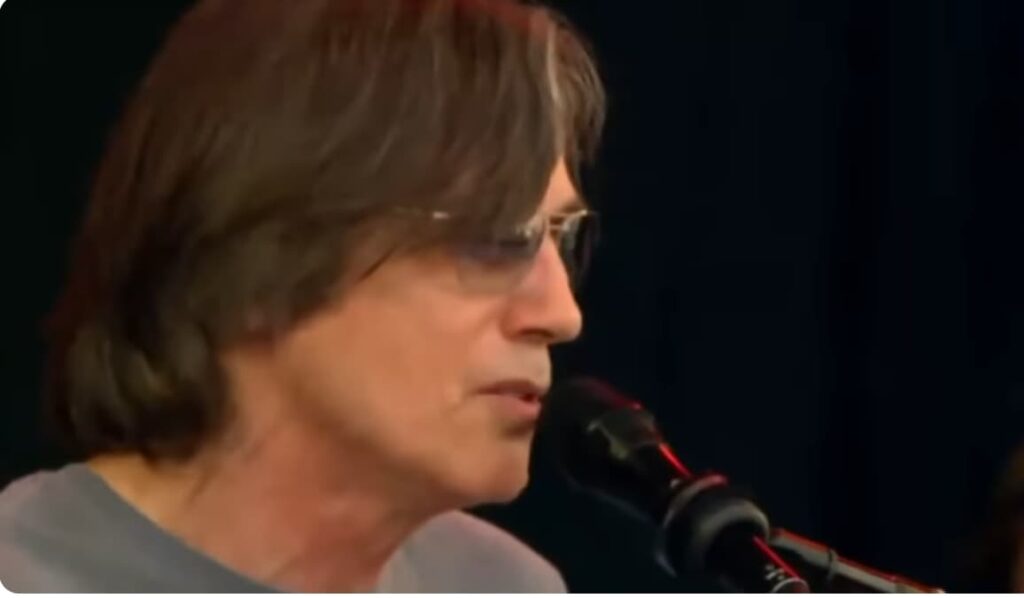
A Song That Never Closed Its Eyes: Jackson Browne at Glastonbury 2010
There are songs that belong to a moment, and there are songs that quietly follow us through life. When Jackson Browne stepped onto the stage at the Glastonbury Festival in 2010 to perform “Doctor My Eyes,” it did not feel like a return to the past. It felt like a continuation of something that had never really left.
Decades after its release, the song carries a different kind of weight. Browne no longer sings it as a young observer trying to make sense of the world. There is a lived experience in his voice now, a sense that the questions within the song have not disappeared, only deepened. The performance is calm, almost understated, but that restraint is exactly what gives it power. Nothing is forced. Nothing is exaggerated.
Behind him, a band of trusted musicians shapes the sound with quiet precision. David Lindley adds his unmistakable touch on lap slide and fiddle, bringing a warmth that longtime listeners will recognize immediately. The arrangement does not attempt to transform the song. Instead, it allows space for every note to breathe, for every lyric to land naturally.
What makes this moment stand out is the contrast between the scale of the festival and the intimacy of the performance. Glastonbury is known for its vast crowds and electric energy, yet here, the atmosphere feels almost personal. It is as if the noise fades just enough for the song to speak clearly again. Browne does not try to command the audience. He simply meets them where they are.
There is also a quiet honesty in how time reveals itself in performances like this. The voice may carry subtle traces of age, but it also carries something more valuable, perspective. “Doctor My Eyes” becomes less about searching for answers and more about acknowledging the journey itself.
Captured by the BBC, the footage preserves this balance between artist, song, and audience without distraction. It does not rely on spectacle. It does not need to. What it offers instead is something rarer, a reminder that a well written song can grow older without losing its meaning.
Watching this performance, one question lingers long after the final note fades. How many songs truly stay with us like this, changing just enough over time to reflect who we have become?