
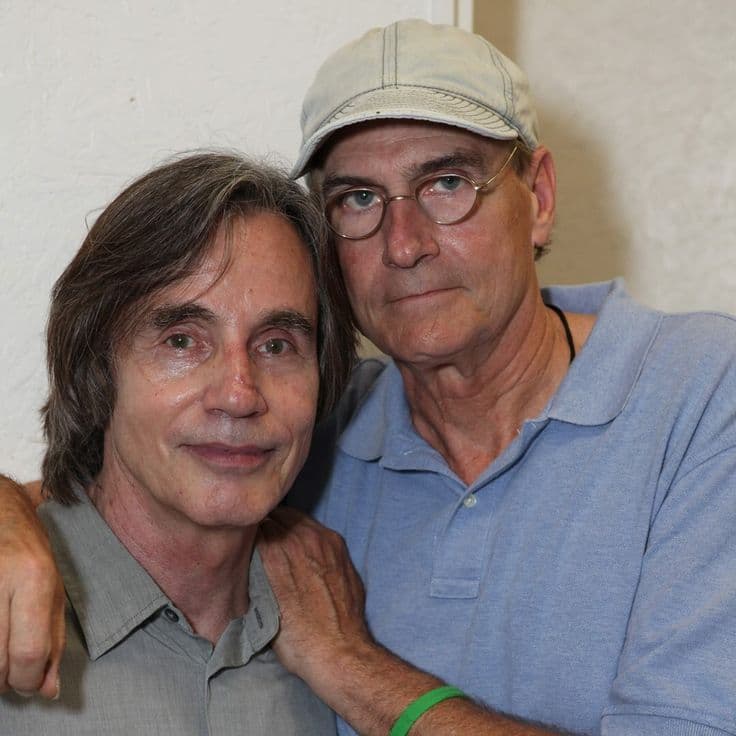
Two Voices, One Road: Jackson Browne and James Taylor Revisit “Running On Empty” with Quiet Authority in 2021
The August 22, 2021 performance of “Running On Empty” at the Lakeview Amphitheater in Syracuse brought together Jackson Browne and James Taylor in a setting that felt both celebratory and reflective. Decades after the song first defined a generation of touring musicians, this live rendition offered something less urgent but far more resonant.
Behind the scenes, the collaboration itself carried weight. Browne and Taylor had long shared overlapping histories within the Southern California music scene of the early 1970s, moving in circles that included artists who shaped what would later be called the Laurel Canyon sound. Their joint tour in 2021 was not built on nostalgia alone but on a genuine artistic kinship that had matured over time. The decision to perform “Running On Empty” together was therefore less a novelty and more a natural convergence.
Originally released in 1977 as the title track of Browne’s landmark album Running on Empty, the studio version captured the restless energy of life on the road. Its rhythm pushed forward with a sense of motion, reflecting exhaustion and persistence in equal measure. Listening now, however, the Syracuse performance reframes that narrative. The tempo feels slightly more measured, the delivery more conversational. Where the original carried urgency, this version leans into reflection.
The contrast between live and studio becomes especially clear in the vocal interplay. Browne’s voice, weathered yet steady, carries the song’s core perspective, while Taylor’s harmonies add a layer of warmth that softens the edges. The instrumentation remains faithful to the original structure, but the dynamic is less about propulsion and more about space. Each phrase is allowed to settle, giving the audience time to absorb not just the melody but the years behind it.
Hearing the song now with older ears inevitably changes its meaning. What once sounded like a declaration of endurance begins to feel like an acknowledgment of distance traveled. Lines that described the grind of touring take on a broader significance, suggesting the passage of time itself. The performance does not attempt to recreate the past. Instead, it accepts it.
There is also a subtle emotional undercurrent tied to the moment. The concert took place in the wake of a global pause in live music, making the return to the stage carry its own quiet significance. Without stating it directly, the performance reflects a renewed appreciation for connection, both between artists and with the audience.
As the song reaches its closing moments, there is no dramatic shift, no attempt to amplify the ending. The restraint is deliberate. Browne and Taylor simply let the song conclude as it was written, trusting its enduring strength. In doing so, they transform “Running On Empty” from a portrait of youthful motion into something more lasting: a meditation on continuity, resilience, and the enduring bond between music and memory.