
When Jackson Browne Became the Scarecrow: A Night Where Classic Rock Met American Myth
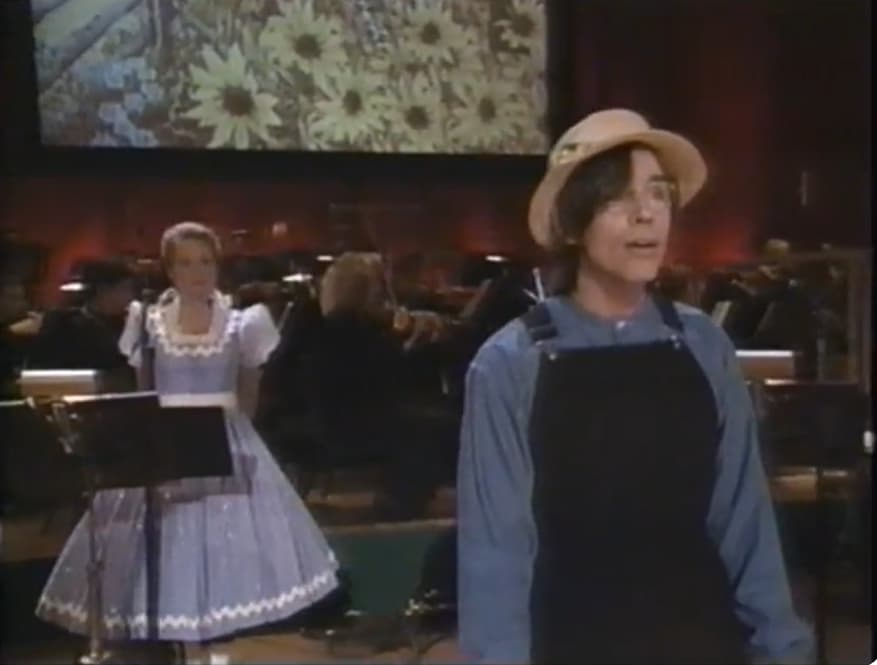
On November 22, 1995, television audiences witnessed an unusual yet quietly magical moment when Jackson Browne stepped into the world of The Wizard of Oz during The Wizard of Oz in Concert: Dreams Come True. Known for his introspective songwriting and ties to the Laurel Canyon era, Browne took on the role of the Scarecrow, performing “If I Only Had A Brain” with a sincerity that blurred the line between tribute and reinvention.
Browne, an artist deeply associated with grounded, emotionally precise music, entered a setting defined by fantasy and nostalgia. Rather than overplaying the role, he approached it with restraint, allowing the song’s inherent charm to breathe. His voice, weathered yet warm, reframed the Scarecrow not as a caricature, but as a quietly reflective figure. In doing so, he revealed an unexpected emotional depth within a song often treated as lighthearted.
Behind the scenes, the concert itself was conceived as both a celebration and a charitable event, bringing together a wide range of performers to reinterpret one of America’s most enduring cultural artifacts. For Browne, this was not a typical career move. Unlike his contemporaries who occasionally leaned into theatrical collaborations, his participation felt deliberate and rare. It hinted at an artist willing to step outside his established identity without compromising it.
There is also a subtle historical resonance in Browne’s casting. Much like the Scarecrow’s search for meaning, Browne’s body of work has long explored themes of self-awareness, doubt, and emotional clarity. The connection may not have been explicit, but it was undeniably present. In that sense, the performance became more than a novelty. It felt aligned with the philosophical undercurrent that runs through his songwriting.
The staging itself leaned into nostalgia, recreating elements familiar to audiences who grew up with the original film. Yet Browne’s presence introduced a different kind of memory, one tied to the reflective, often bittersweet tone of 1970s American songwriting. That tension between innocence and introspection gave the moment its unique character.
For longtime listeners, the performance offers something quietly fascinating: a glimpse of Jackson Browne in a space where narrative takes precedence over authorship. He is not the writer here, but the interpreter. And in that role, he demonstrates a different kind of artistry, one rooted in respect for the material and an instinct for emotional truth.
Decades later, the clip remains an intriguing footnote in his career. Not because it was grand or transformative, but because it was unexpected and, in its own understated way, revealing.