
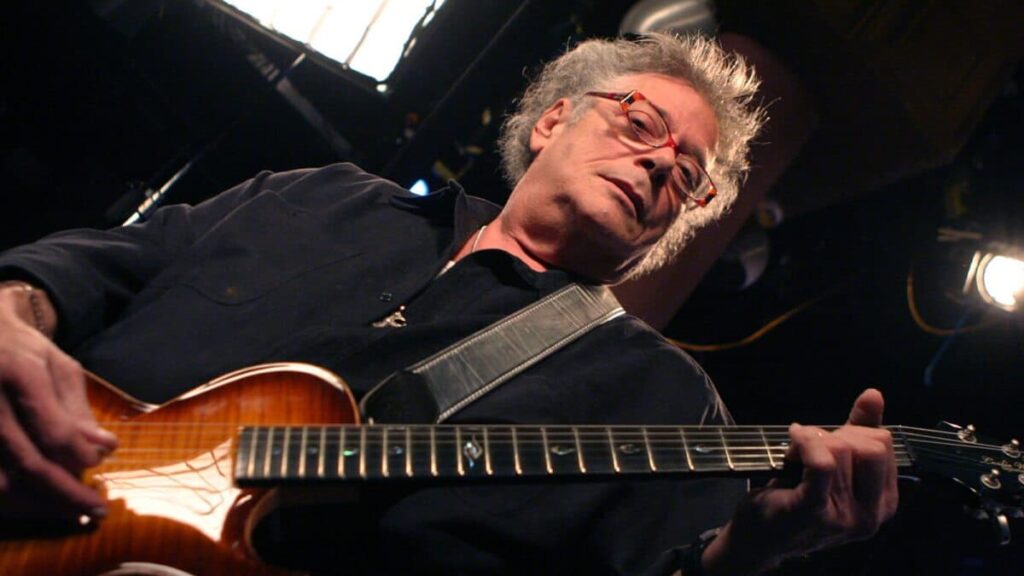
A Song About a River, Played by a Man Who Had Already Crossed Too Many
By the time Leslie West stood on stage to play “By The River,” the story behind the song had already changed.
Back in 1976, when it appeared on The Leslie West Band, the track felt almost incidental. A short, understated piece released in the shadow of his past with Mountain, a band that had thrived on volume, weight, and sheer force. At that point, “By The River” sounded like a quiet detour. Maybe even something easily overlooked.
But years later, on stage, it no longer plays like a detour. It feels like a destination.
There is a subtle but important shift in how West approaches it. He does not introduce the song like a highlight. There is no sense of “now comes this track.” Instead, he moves into it almost casually, as if continuing a conversation only he remembers. That alone reframes the entire performance. The audience is not being presented with a song. They are being let in on something already in progress.
This is where the backstory starts to surface without being spoken.
After the collapse of his earlier momentum and the constant reshaping of his career, West was no longer the same guitarist who once stood at the center of a loud, rising movement. By the time of this performance, he had already lived through the arc most rock musicians fear: breakthrough, excess, fragmentation, and survival. That history sits quietly inside “By The River.”
And you can hear it in what he chooses not to do.
He does not expand the song dramatically. He does not turn it into a showcase. If anything, he holds it back. The phrases feel shorter, the spaces longer. It is as if he is resisting the instinct to turn the moment into something bigger. That restraint becomes the real narrative. A younger West might have filled the gaps. This version leaves them open.
The connection between the song and the performance becomes almost literal at that point.
“By The River” is built on the image of something constantly moving forward, never stopping, never resolving. In this live setting, that idea mirrors his own position. He is not revisiting the past in a nostalgic way. He is standing inside it, aware of it, but not trying to rewrite it. The performance carries that acceptance.
Even the ending reflects this mindset. There is no grand closing gesture, no attempt to “complete” the story. The song simply fades out of his hands, like a thought he chooses not to finish. It feels less like an ending and more like a continuation happening somewhere beyond the stage.
That is what makes this performance worth watching closely.
Not the notes. Not the technique.
But the way a seemingly minor song, written in a transitional moment, slowly transforms into something else over time. A quiet document of where an artist ends up after everything that was supposed to define him has already passed.