
Back to the Raw Core: Status Quo Reflect on Sound, Struggle, and Starting Over
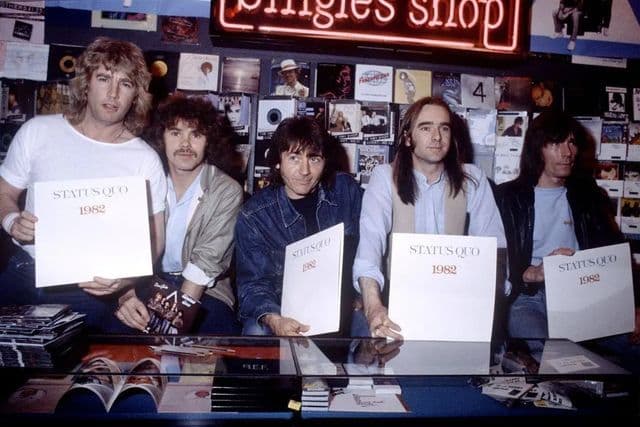
In a 1982 studio interview promoting the album 1+9+8+2, members of Status Quo offered a rare and candid look into a period of transition that reshaped their identity. Rather than celebrating success, Francis Rossi, Rick Parfitt, and Alan Lancaster focused on missteps, recalibration, and the long process of rediscovering their sound.
One of the most revealing threads in the conversation is the band’s evolving relationship with producers. After years of relentless touring and recording, they reached a point where routine began to replace inspiration. The decision to work with producer Pip Williams marked a shift toward a more polished and technically refined sound, particularly during the Rockin’ All Over the World era. At the time, this felt like progress. In hindsight, the band recognized it came at a cost.
They describe that period with surprising honesty. The production was clean, even “correct” in a technical sense, but something essential had been softened. For a group built on a raw, driving energy, that refinement created distance between the music and its original spirit. Audience feedback confirmed it. Listeners began to notice the change, describing the sound as too smooth, even “too nice.”
This realization did not come immediately. It emerged gradually, as the band experimented with different studios, recording methods, and production approaches. They speak about chasing a balance between clarity and chaos, trying to recapture the live energy that defined their earlier work without abandoning the lessons they had learned. It was not a straight path. It involved trial, error, and a willingness to admit that certain decisions had taken them away from what made them unique.
Another key moment in the discussion is the origin of “Rockin’ All Over the World.” Initially, the track was not an obvious choice. The band members themselves were hesitant. It was only after hearing it externally that the idea took hold, eventually becoming one of their most recognizable songs. This detail highlights how instinct and uncertainty often coexist in creative decisions.
The interview also underscores the physical and mental toll of constant touring. After years of non stop activity, the band took a break, something they now view as necessary. That pause allowed them to reassess not just their schedule, but their direction.
By 1982, 1+9+8+2 represented more than a new release. It was an attempt to unify their process, recording and finishing the album in a single environment to maintain consistency. More importantly, it signaled a return to something closer to their core identity.
What makes this interview compelling is its lack of mythology. There is no attempt to rewrite history. Instead, it captures a band openly navigating its own evolution, acknowledging that sometimes moving forward requires stepping away from what once seemed like progress.