
The Founder Looked Back: Alan Lancaster Reclaims a Psychedelic Origin on Television
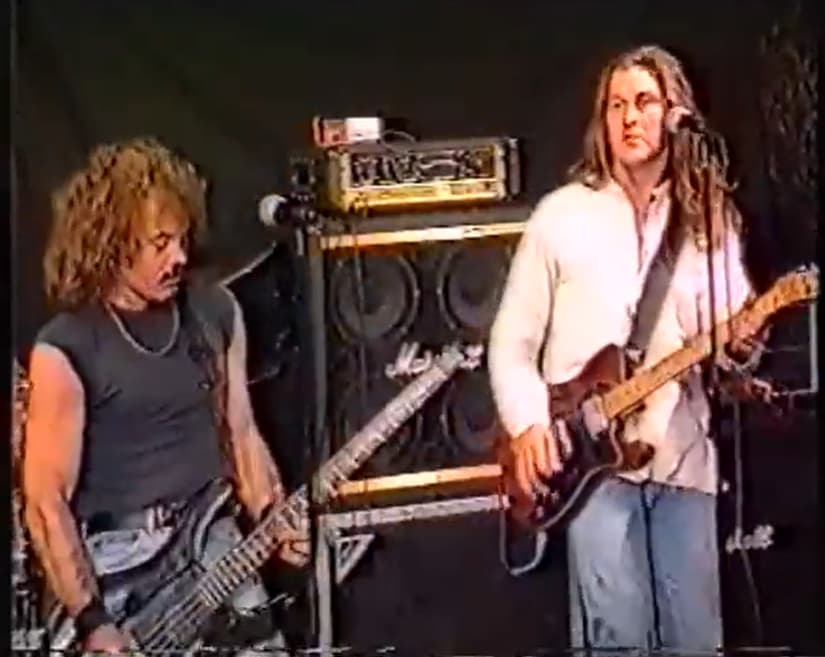
In a rare and quietly compelling television moment, Alan Lancaster stepped back into one of rock’s most defining early chapters, performing “Pictures of Matchstick Men” not with Status Quo, but with his later project, The Bombers. What unfolded was not simply a performance, but a subtle act of reclamation.
By the time of this appearance, Lancaster had long parted ways with Status Quo, following internal tensions that reshaped the band’s trajectory in the early 1980s. Relocating to Australia, he formed The Bombers and pursued a sound that leaned more toward straightforward, unvarnished rock. Revisiting “Pictures of Matchstick Men” in this context carried a deeper implication. This was not nostalgia for its own sake. It was a founding member reasserting his connection to a song that had once launched a career.
Originally released in 1968, the track stood apart from the boogie-driven identity that would later define Status Quo. Built on a psychedelic framework, it captured a moment when the band’s direction was still fluid, exploratory, and aligned with the broader late sixties experimentation. In Lancaster’s hands, however, the song takes on a different character. Stripped of its dreamlike haze, it becomes more grounded, more direct, reflecting the musical path he chose after leaving the group.
There is an unavoidable sense of duality in the performance. Without longtime collaborators such as Francis Rossi, the song feels both familiar and altered, as if viewed through a different lens. For audiences, this creates a compelling tension. It raises a question that has followed many legacy acts over time. Who truly defines the essence of a band’s early sound?
The television format adds another layer to the experience. Unlike an expansive live concert, the setting is controlled and concise, forcing the performance into a tighter frame. Yet this limitation works in Lancaster’s favor. The absence of extended improvisation places focus squarely on his presence and interpretation, turning the moment into a personal statement rather than a communal spectacle.
Perhaps most striking is the thematic resonance between the song and the performer himself. “Pictures of Matchstick Men” speaks to an inescapable fixation, an image that lingers beyond reason. In many ways, Lancaster embodies that idea. Though separated from Status Quo, he remains intrinsically tied to its origins, unable and perhaps unwilling to fully detach from the past he helped create.
For longtime listeners, the performance offers more than a revisiting of a classic. It presents an alternate history, a glimpse of what the band’s legacy might have looked like under a different guiding force.