
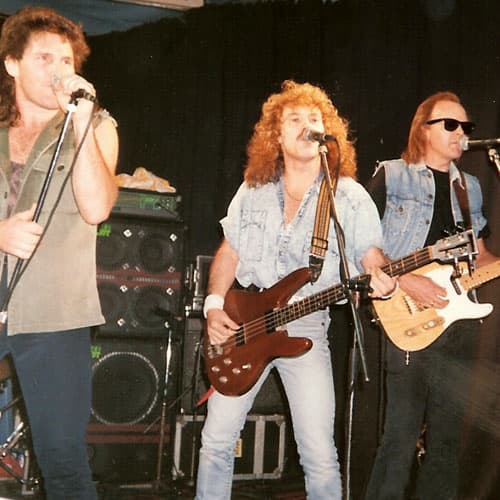
Running Toward the Light That Never Came: The Quiet Fate of The Bombers
There is something quietly unsettling about watching The Bombers perform “Running in the Shadows.” Not because of what is lacking, but because of what is present. The energy is there. The experience is undeniable. And yet, the feeling that lingers is not triumph, but distance.
Formed in the late 1980s, The Bombers carried the weight of expectation almost by default. With Alan Lancaster, a founding member of Status Quo, at its core, the band represented more than a fresh start. It was a continuation, a second act shaped by history. Alongside seasoned musicians, the project had all the visible components of success. What it did not have was time.
“Running in the Shadows,” drawn from their 1990 album Aim High, now feels less like a conventional rock track and more like an unintended reflection of the band’s trajectory. The title alone suggests movement without arrival, effort without recognition. In performance, that idea becomes almost tangible. There is a forward drive in the rhythm, a sense of urgency in the delivery, yet it never quite resolves into something definitive. It moves, but it does not land.
Lancaster’s presence anchors the performance. He does not appear as someone trying to reclaim past glory, but rather as a musician continuing forward, carrying the weight of what came before without being consumed by it. There is a restraint in that approach, a quiet determination that contrasts sharply with the larger, more visible legacy he once helped build.
The late 1980s and early 1990s were a period of transition within rock music. Sounds were shifting, audiences were changing, and bands that might have thrived a decade earlier often found themselves caught between eras. The Bombers existed within that space. Their music was solid, direct, and grounded, yet it arrived at a moment when the landscape was already moving elsewhere.
This context gives “Running in the Shadows” an added layer of poignancy. It is not simply a song about obscurity. It is a performance that embodies it. The band is present, fully formed, yet somehow just outside the frame of wider recognition.
Looking back, the clip holds a different kind of value. It is not a document of success, but of persistence. A reminder that in music, as in life, not every path leads to the spotlight. Some remain just beyond it, defined not by failure, but by the quiet dignity of continuing anyway.