
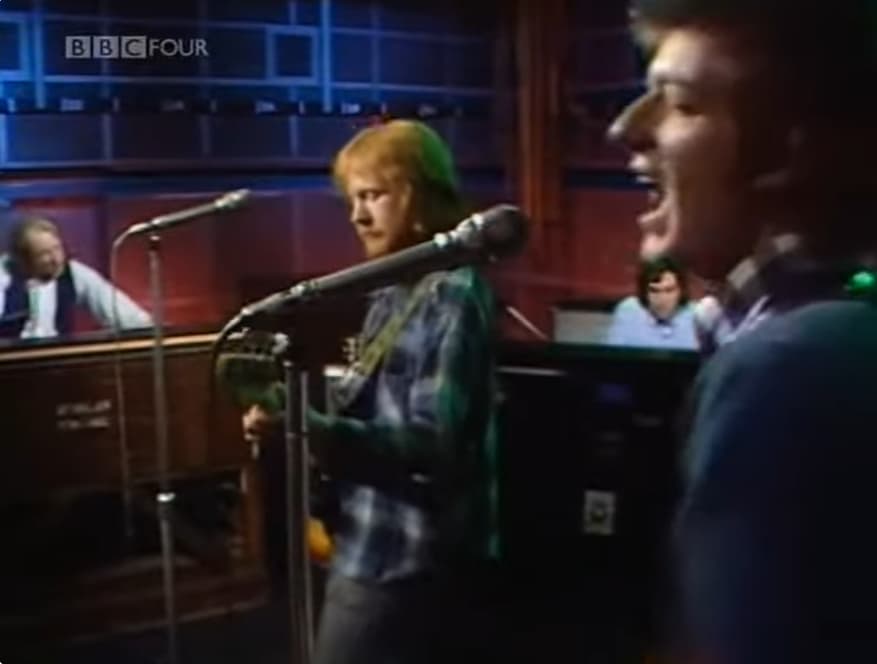
Before the Spotlight, There Was the Groove: Brinsley Schwarz on The Old Grey Whistle Test
Long before punk stripped rock back to its essentials, bands like Brinsley Schwarz were already doing the work. Their performance of “Surrender To The Rhythm” on The Old Grey Whistle Test captures a moment when music was less about spectacle and more about feel, a philosophy that would quietly reshape the direction of British rock.
From the very first seconds, the performance rejects any sense of theatrical buildup. There is no dramatic entrance, no attempt to command attention. Instead, the band drops straight into the groove, as if the song had already been playing before the cameras started rolling. It creates an immediacy that feels disarming. The audience is not invited in gently. They are pulled directly into the rhythm.
That approach defines the essence of pub rock, a movement that stood in deliberate contrast to the complexity of progressive rock and the flamboyance of glam. Where others pursued scale, Brinsley Schwarz pursued connection. “Surrender To The Rhythm” is not constructed around technical showmanship but around cohesion. The rhythm section remains steady and grounded, allowing the guitars and vocals to move freely, almost conversationally. It is music that prioritizes instinct over precision.
There is a deeper layer to the performance that becomes clearer with hindsight. Pub rock, often overlooked in mainstream narratives, served as a crucial bridge between the excess of early 1970s rock and the raw directness of punk. Bands like Brinsley Schwarz created a template built on simplicity, accessibility, and authenticity. Watching this performance now, it is possible to trace the DNA of what would soon follow.
The setting of The Old Grey Whistle Test enhances this authenticity. Known for showcasing artists outside the commercial spotlight, the program provided a rare platform where musicians could perform without compromise. The stripped-down production places the focus entirely on the band, eliminating distractions and reinforcing the intimacy of the moment.
As the song progresses, its title becomes its guiding principle. The band does not control the rhythm so much as yield to it. There is a looseness in the performance, a willingness to let the music breathe. Even the ending resists closure. Rather than building toward a dramatic finale, the song simply settles, as if the performance could continue indefinitely beyond the frame.
“Surrender To The Rhythm” is more than a song in this context. It is a statement of intent. In its unassuming way, it reminds us that before rock became larger than life, it was something far more human, built on feel, spontaneity, and the quiet power of musicians playing together in the moment.